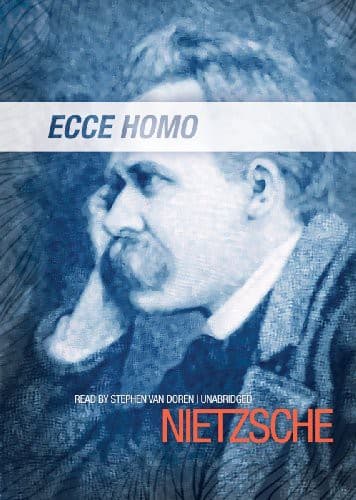
Ecce Homo: Complete Works, Volume SeventeenNietzsche, Friedrich Wilhelm
PhilosophyPhilosophy
Ecce Homo: Complete Works, Volume Seventeen
Nietzsche, Friedrich Wilhelm
Nietzsche, Friedrich Wilhelm, 1844-1900; Philosophers -- Germany -- Biography
of Christianity, am far from holding the individual responsible for
what is the fatality of long ages.
May I be allowed to hazard a suggestion concerning one last trait
in my character, which in my intercourse with other men has led me
into some difficulties? I am gifted with a sense of cleanliness the
keenness of which is phenomenal; so much so, that I can ascertain
physiologically--that is to say, smell--the proximity, nay, the inmost
core, the "entrails" of every human soul.... This sensitiveness of mine
is furnished with psychological antennæ, wherewith I feel and grasp
every secret: the quality of concealed filth lying at the base of many
a human character which may be the inevitable outcome of base blood,
and which education may have veneered, is revealed to me at the first
glance. If my observation has been correct, such people, whom my sense
of cleanliness rejects, also become conscious, on their part, of the
cautiousness to which my loathing prompts me: and this does not make
them any more fragrant.... In keeping with a custom which I have long
observed,--pure habits and honesty towards myself are among the first
conditions of my existence, I would die in unclean surroundings,--I
swim, bathe, and splash about, as it were, incessantly in water, in
any kind of perfectly transparent and shining element. That is why
my relations with my fellows try my patience to no small extent; my
humanity does not consist in the fact that I understand the feelings
of my fellows, but that I can endure to understand.... My humanity
is a perpetual process of self-mastery. But I need solitude--that is
to say, recovery, return to myself, the breathing of free, crisp,
bracing air.... The whole of my _Zarathustra_ is a dithyramb in honour
of solitude, or, if I have been understood, in honour of purity. Thank
Heaven, it is not in honour of "pure foolery"![3] He who has an eye for
colour will call him a diamond. The loathing of mankind, of the rabble,
was always my greatest danger.... Would you hearken to the words spoken
by Zarathustra concerning deliverance from loathing?
"What forsooth hath come unto me? How did I deliver myself from
loathing? Who hath made mine eye younger? How did I soar to the height,
where there are no more rabble sitting about the well?
"Did my very loathing forge me wings and the strength to scent
fountains afar off? Verily to the loftiest heights did I need to fly,
to find once more the spring of joyfulness.
"Oh, I found it, my brethren! Up here, on the loftiest height, the
spring of joyfulness gusheth forth for me. And there is a life at the
well of which no rabble can drink with you.
"Almost too fiercely dost thou rush, for me, thou spring of joyfulness!
And ofttimes dost thou empty the pitcher again in trying to fill it.
"And yet must I learn to draw near thee more humbly. Far too eagerly
doth my heart jump to meet thee.
Public-domain text, read in full here on John Shaqi.
Reviews
Reviews
No reviews yet
Be the first to share your thoughts on this work.
Join the Discussion
Join the discussion
Sign in to leave a comment or review.
Sign InorCreate an account