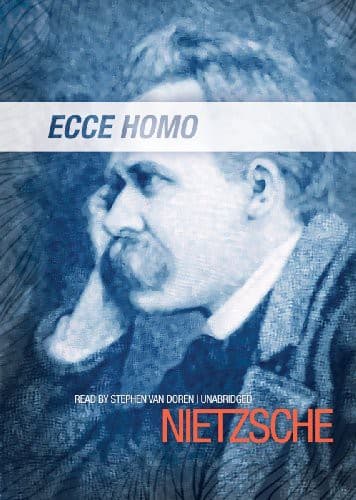
Ecce Homo: Complete Works, Volume SeventeenNietzsche, Friedrich Wilhelm
PhilosophyPhilosophy
Ecce Homo: Complete Works, Volume Seventeen
Nietzsche, Friedrich Wilhelm
Nietzsche, Friedrich Wilhelm, 1844-1900; Philosophers -- Germany -- Biography
To those who know Nietzsche's life-work, no apology will be needed
for the form and content of this wonderful work. They will know, at
least, that a man either is, or is not, aware of his significance and
of the significance of what he has accomplished, and that if he is
aware of it, then self-realisation, even of the kind which we find
in these pages, is neither morbid nor suspicious, but necessary and
inevitable. Such chapter headings as "Why I am so Wise," "Why I am a
Fatality," "Why I write such Excellent Books,"--however much they may
have disturbed the equanimity, and "objectivity" in particular, of
certain Nietzsche biographers, can be regarded as pathological only
in a democratic age in which people have lost all sense of graduation
and rank and in which the virtues of modesty and humility have to be
preached far and wide as a corrective against the vulgar pretensions of
thousands of wretched nobodies. For little people can be endured only
as modest citizens; or humble Christians. If, however, they demand a
like modesty on the part of the truly great; if they raise their voices
against Nietzsche's lack of the very virtue they so abundantly possess
or pretend to possess, it is time to remind them of Goethe's famous
remark: "_Nur Lumpe sind bescheiden_" (Only nobodies are ever modest).
It took Nietzsche barely three weeks to write this story of his life.
Begun on the 15th of October 1888, his four-and-fourtieth birthday,
it was finished on the 4th of November of the same year, and, but
for a few trifling modifications and additions, is just as Nietzsche
left it. It was not published in Germany until the year 1908, eight
years after Nietzsche's death. In a letter dated the 27th of December
1888, addressed to the musical composer Fuchs, the author declares
the object of the work to be to dispose of all discussion, doubt, and
inquiry concerning his own personality, in order to leave the public
mind free to consider merely "the things for the sake of which he
existed" ("_die Dinge, derentwegen ich da bin_"). And, true to his
intention, Nietzsche's honesty in these pages is certainly one of
the most remarkable features about them. From the first chapter, in
which he frankly acknowledges the decadent elements within him, to
the last page, whereon he characterises his mission, his life-task,
and his achievement, by means of the one symbol, _Dionysus_ versus
_Christ,_--everything comes straight from the shoulder, without
hesitation, without fear of consequences, and, above all, without
concealment. Only in one place does he appear to conceal something, and
then he actually leads one to understand that he is doing so. It is in
regard to Wagner, the greatest friend of his life. "Who doubts," he
says, "that I, old artillery-man that I am, would be able if I liked to
point my heavy guns at Wagner?"--But he adds: "Everything decisive in
this question I kept to myself--I have loved Wagner" (p. 122).
Public-domain text, read in full here on John Shaqi.
Reviews
Reviews
No reviews yet
Be the first to share your thoughts on this work.
Join the Discussion
Join the discussion
Sign in to leave a comment or review.
Sign InorCreate an account