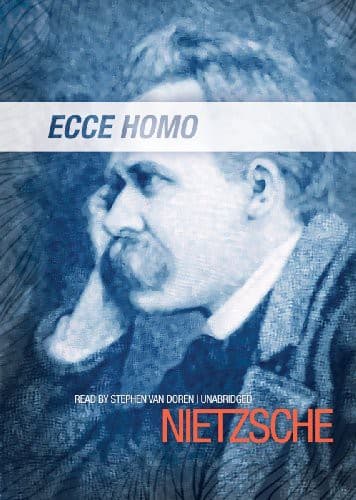
Ecce Homo: Complete Works, Volume SeventeenNietzsche, Friedrich Wilhelm
PhilosophyPhilosophy
Ecce Homo: Complete Works, Volume Seventeen
Nietzsche, Friedrich Wilhelm
Nietzsche, Friedrich Wilhelm, 1844-1900; Philosophers -- Germany -- Biography
Why do I know more things than other people? Why, in fact, am I so
clever? I have never pondered over questions that are not questions. I
have never squandered my strength. Of actual religious difficulties,
for instance, I have no experience. I have never known what it is to
feel "sinful." In the same way I completely lack any reliable criterion
for ascertaining what constitutes a prick of conscience: from all
accounts a prick of conscience does not seem to be a very estimable
thing.... Once it was done I should hate to leave an action of mine
in the lurch; I should prefer completely to omit the evil outcome,
the consequences, from the problem concerning the value of an action.
In the face of evil consequences one is too ready to lose the proper
standpoint from which one's deed ought to be considered. A prick of
conscience strikes me as a sort of "evil eye." Something that has
failed should be honoured all the more jealously, precisely because
it has failed--this is much more in keeping with my morality.--"God,"
"the immortality of the soul," "salvation," a "beyond"--to all these
notions, even as a child, I never paid any attention whatsoever, nor
did I waste any time upon them,--maybe I was never _naif_ enough for
that?--I am quite unacquainted with atheism as a result, and still
less as an event in my life: in me it is inborn, instinctive. I am
too inquisitive, too incredulous, too high spirited, to be satisfied
with such a palpably clumsy solution of things. God is a too palpably
clumsy solution of things; a solution which shows a lack of delicacy
towards us thinkers--at bottom He is really no more than a coarse
and rude _prohibition_ of us: ye shall not think!... I am much more
interested in another question,--a question upon which the "salvation
of humanity" depends to a far greater degree than it does upon any
piece of theological curiosity: I refer to nutrition. For ordinary
purposes, it may be formulated as follows: "How precisely must _thou_
feed thyself in order to attain to thy maximum of power, or _virtù_
in the Renaissance style,--of virtue free from moralic acid?" My
experiences in regard to this matter have been as bad as they possibly
could be; I am surprised that I set myself this question so late in
life, and that it took me so long to draw "rational" conclusions
from my experiences. Only the absolute worth-_1_ lessness of German
culture--its "idealism"--can to some extent explain how it was that
precisely in this matter I was so backward that my ignorance was almost
saintly. This "culture," which from first to last teaches one to lose
sight of actual things and to hunt after thoroughly problematic and
so-called ideal aims, as, for instance, "classical culture"--as if it
were not hopeless from the start to try to unite "classical" and
"German" in one concept. It is even a little comical--try and imagine
a "classically cultured" citizen of Leipzig!--Indeed, I can say, that
Public-domain text, read in full here on John Shaqi.
Reviews
Reviews
No reviews yet
Be the first to share your thoughts on this work.
Join the Discussion
Join the discussion
Sign in to leave a comment or review.
Sign InorCreate an account