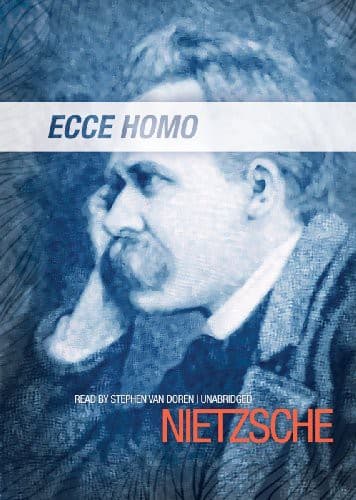
Ecce Homo: Complete Works, Volume SeventeenNietzsche, Friedrich Wilhelm
PhilosophyPhilosophy
Ecce Homo: Complete Works, Volume Seventeen
Nietzsche, Friedrich Wilhelm
Nietzsche, Friedrich Wilhelm, 1844-1900; Philosophers -- Germany -- Biography
After the choice of nutrition, the choice of climate and locality, the
third matter concerning which one must not on any account make a
blunder, is the choice of the manner in which one _recuperates one's
strength._ Here, again, according to the extent to which a spirit is
_sui generis,_ the limits of that which he can allow himself--in other
words, the limits of that which is beneficial to him--become more and
more confined. As far as I in particular am concerned, _reading_ in
general belongs to my means of recuperation; consequently it belongs
to that which rids me of myself, to that which enables me to wander
in strange sciences and strange souls--to that, in fact, about which
I am no longer in earnest. Indeed, it is while reading that I recover
from _my_ earnestness. During the time that I am deeply absorbed in
my work, no books are found within my reach; it would never occur
to me to allow any one to speak or even to think in my presence.
For that is what reading would mean.... Has any one ever actually
noticed, that, during the period of profound tension to which the
state of pregnancy condemns not only the mind, but also, at bottom,
the whole organism, accident and every kind of external stimulus acts
too acutely and strikes too deep? Accident and external stimuli must,
as far as possible, be avoided: a sort of walling-of-one's-self-in is
one of the primary instinctive precautions of spiritual pregnancy.
Shall I allow a strange thought to steal secretly over the wall?
For that is what reading would mean.... The periods of work and
fruit-fulness are followed by periods of recuperation: come hither,
ye delightful, intellectual, intelligent books! Shall I read German
books?... I must go back six months to catch myself with a book in
my hand. What was it? An excellent study by Victor Brochard upon the
Greek sceptics, in which my Laertiana[1] was used to advantage. The
sceptics!--the only _honourable_ types among that double-faced and
sometimes quintuple-faced throng, the philosophers!.... Otherwise I
almost always take refuge in the same books: altogether their number
is small; they are books which are precisely my proper fare. It is
not perhaps in my nature to read much, and of all sorts: a library
makes me ill. Neither is it my nature to love much or many kinds of
things. Suspicion or even hostility towards new books is much more
akin to my instinctive feeling than "toleration," _largeur de cœur,_
and other forms of "neighbour-love." ... It is to a small number of
old French authors, that I always return again and again; I believe
only in French culture, and regard everything else in Europe which
calls itself "culture" as a misunderstanding. I do not even take
the German kind into consideration.... The few instances of higher
culture with which I have met in Germany were all French in their
origin. The most striking example of this was Madame Cosima Wagner,
by far the most decisive voice in matters of taste that I have ever
heard.
Public-domain text, read in full here on John Shaqi.
Reviews
Reviews
No reviews yet
Be the first to share your thoughts on this work.
Join the Discussion
Join the discussion
Sign in to leave a comment or review.
Sign InorCreate an account