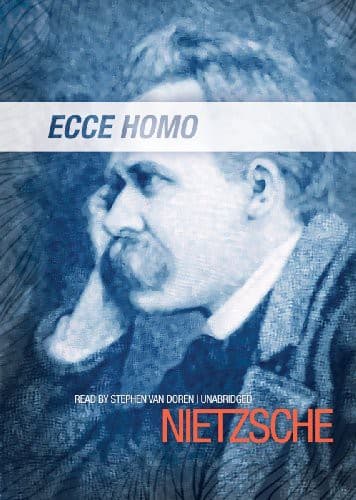
Ecce Homo: Complete Works, Volume SeventeenNietzsche, Friedrich Wilhelm
PhilosophyPhilosophy
Ecce Homo: Complete Works, Volume Seventeen
Nietzsche, Friedrich Wilhelm
Nietzsche, Friedrich Wilhelm, 1844-1900; Philosophers -- Germany -- Biography
of suppleness, cunning, and prudence--in short, a born adventurer and
explorer. After all, I could not describe better than _Zarathustra_ has
done unto whom I really address myself: unto whom alone would he reveal
his riddle?
"Unto you, daring explorers and experimenters, and unto all who have
ever embarked beneath cunning sails upon terrible seas;
"Unto you who revel in riddles and in twilight, whose souls are lured
by flutes unto every treacherous abyss:
"For ye care not to grope your way along a thread with craven fingers;
and where ye are able to _guess,_ ye hate to _argue_?"
4
I will now pass just one or two general remarks about my _art of
style._ To communicate a state an inner tension of pathos by means
of signs, including the tempo of these signs,--that is the meaning of
every style; and in view of the fact that the multiplicity of inner
states in me is enormous, I am capable of many kinds of style--in
short, the most multifarious art of style that any man has ever had at
his disposal. Any style is _good_ which genuinely communicates an inner
condition, which does not blunder over the signs, over the tempo of the
signs, or over _moods_--all the laws of phrasing are the outcome of
representing moods artistically. Good style, in itself, is a piece of
sheer foolery, mere idealism, like "beauty in itself," for instance,
or "goodness in itself," or "the thing-in-itself." All this takes for
granted, of course, that there exist ears that can hear, and such men
as are capable and worthy of a like pathos, that those are not wanting
unto whom one may communicate one's self. Meanwhile my Zarathustra,
for instance, is still in quest of such people--alas! he will have to
seek a long while yet! A man must be worthy of listening to him....
And, until that time, there will be no one who will understand the art
that has been squandered in this book. No one has ever existed who has
had more novel, more strange, and purposely created art forms to fling
to the winds. The fact that such things were possible in the German
language still awaited proof; formerly, I myself would have denied
most emphatically that it was possible. Before my time people did not
know what could be done with the German language--what could be done
with language in general. The art of grand rhythm, of grand style in
periods, for expressing the tremendous fluctuations of sublime and
superhuman passion, was first discovered by me: with the dithyramb
entitled "The Seven Seals," which constitutes the last discourse of
the third part of _Zarathustra,_ I soared miles above all that which
heretofore has been called poetry.
5
Public-domain text, read in full here on John Shaqi.
Reviews
Reviews
No reviews yet
Be the first to share your thoughts on this work.
Join the Discussion
Join the discussion
Sign in to leave a comment or review.
Sign InorCreate an account