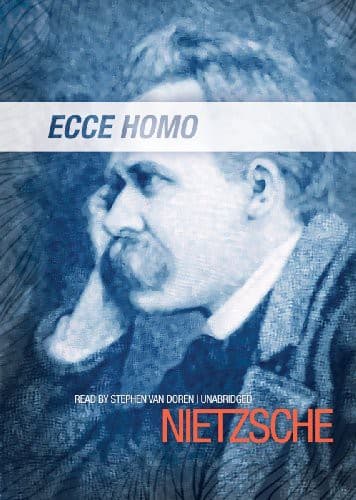
Ecce Homo: Complete Works, Volume SeventeenNietzsche, Friedrich Wilhelm
PhilosophyPhilosophy
Ecce Homo: Complete Works, Volume Seventeen
Nietzsche, Friedrich Wilhelm
Nietzsche, Friedrich Wilhelm, 1844-1900; Philosophers -- Germany -- Biography
Of these four attacks, the first met with extraordinary success. The
stir which it created was in every way gorgeous. I had put my finger
on the vulnerable spot of a triumphant nation--I had told it that its
victory was not a red-letter day for culture, but, perhaps, something
very different. The reply rang out from all sides, and certainly not
only from old friends of David Strauss, whom I had made ridiculous
as the type of a German Philistine of Culture and a man of smug
self-content--in short, as the author of that suburban gospel of his,
called _The Old and the New Faith_ (the term "Philistine of Culture"
passed into the current language of Germany after the appearance of my
book). These old friends, whose vanity as Würtembergians and Swabians
I had deeply wounded in regarding their unique animal, their bird
of Paradise, as a trifle comic, replied to me as ingenuously and as
grossly as I could have wished. The Prussian replies were smarter; they
contained more "Prussian blue." The most disreputable attitude was
assumed by a Leipzig paper, the egregious _Grentzboten_; and it cost me
some pains to prevent my indignant friends in Bâle from taking action
against it. Only a few old gentlemen decided in my favour, and for
very diverse and sometimes unaccountable reasons. Among them was one,
Ewald of Göttingen, who made it clear that my attack on Strauss had
been deadly. There was also the Hegelian, Bruno Bauer, who from that
time became one of my most attentive readers. In his later years he
liked to refer to me, when, for instance, he wanted to give Herr von
Treitschke, the Prussian Historiographer, a hint as to where he could
obtain information about the notion "Culture," of which he (Herr von
T.) had completely lost sight. The weightiest and longest notice of my
book and its author appeared in Würzburg, and was written by Professor
Hoffmann, an old pupil of the philosopher von Baader. The essays made
him foresee a great future for me, namely, that of bringing about a
sort of crisis and decisive turning-point in the problem of atheism,
of which he recognised in me the most instinctive and most radical
advocate. It was atheism that had drawn me to Schopenhauer. The review
which received by far the most attention, and which excited the most
bitterness, was an extraordinarily powerful and plucky appreciation of
my work by Carl Hillebrand, a man who was usually so mild, and the last
_humane_ German who knew how to wield a pen. The article appeared in
the _Augsburg Gazette,_ and it can be read to-day, couched in rather
more cautious language, among his collected essays. In it my work was
referred to as an event, as a decisive turning-point, as the first sign
of an awakening, as an excellent symptom, and as an actual revival
of German earnestness and of German passion in things spiritual.
Hillebrand could speak only in the terms of the highest respect, of
the form of my book, of its consummate taste, of its perfect tact in
Public-domain text, read in full here on John Shaqi.
Reviews
Reviews
No reviews yet
Be the first to share your thoughts on this work.
Join the Discussion
Join the discussion
Sign in to leave a comment or review.
Sign InorCreate an account