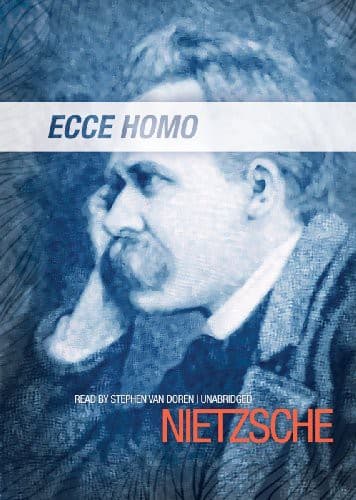
Ecce Homo: Complete Works, Volume SeventeenNietzsche, Friedrich Wilhelm
PhilosophyPhilosophy
Ecce Homo: Complete Works, Volume Seventeen
Nietzsche, Friedrich Wilhelm
Nietzsche, Friedrich Wilhelm, 1844-1900; Philosophers -- Germany -- Biography
At this time my instincts turned resolutely against any further
yielding or following on my part, and any further misunderstanding
of myself. Every kind of life, the most unfavourable circumstances,
illness, poverty--anything seemed to me preferable to that undignified
"selfishness" into which I had fallen; in the first place, thanks to my
ignorance and youth, and in which I had afterwards remained owing to
laziness--the so-called "sense of duty." At this juncture there came to
my help, in a way that I cannot sufficiently admire, and precisely at
the right time, that evil heritage which I derive from my father's side
of the family, and which, at bottom, is no more than a predisposition
to die young. Illness slowly liberated me from the toils, it spared me
any sort of sudden breach, any sort of violent and offensive step. At
that time I lost not a particle of the good will of others, but rather
added to my store. Illness likewise gave me the right completely to
reverse my mode of life; it not only allowed, it actually commanded,
me to forget; it bestowed upon me the necessity of lying still, of
having leisure, of waiting, and of exercising patience.... But all
this means thinking!... The state of my eyes alone put an end to all
book-wormishness, or, in plain English--philology: I was thus delivered
from books; for years I ceased from reading, and this was the greatest
boon I ever conferred upon myself! That nethermost self, which was,
as it were, entombed, and which had grown dumb because it had been
forced to listen perpetually to other selves (for that is what reading
means!), slowly awakened; at first it was shy and doubtful, but at
last it _spoke again_ Never have I rejoiced more over my condition
than during the sickest and most painful moments of my life. You have
only to examine _The Dawn of Day,_ or, perhaps, _The Wanderer and
his Shadow,_[3] in order to understand what this "return to myself"
actually meant: in itself it was the highest kind of recovery!... My
cure was simply the result of it.
5
Public-domain text, read in full here on John Shaqi.
Reviews
Reviews
No reviews yet
Be the first to share your thoughts on this work.
Join the Discussion
Join the discussion
Sign in to leave a comment or review.
Sign InorCreate an account