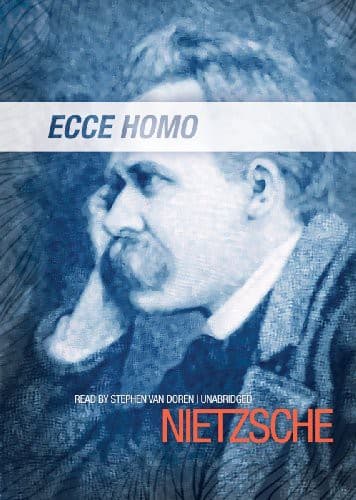
Ecce Homo: Complete Works, Volume SeventeenNietzsche, Friedrich Wilhelm
PhilosophyPhilosophy
Ecce Homo: Complete Works, Volume Seventeen
Nietzsche, Friedrich Wilhelm
Nietzsche, Friedrich Wilhelm, 1844-1900; Philosophers -- Germany -- Biography
the attempts of the people of Leipzig to do honour to one of the most
genuine and most German of musicians,--using German here in the old
sense of the word,--a man who was no mere German of the Empire, the
master Heinrich Schütz, by founding a Liszt Society, the object of
which was to cultivate and spread artful (_listige_[3]) Church music.
Without a shadow of doubt the Germans are idealists.
2
But here nothing shall stop me from being rude, and from telling the
Germans one or two unpleasant home truths: who else would do it if I
did not? I refer to their laxity in matters historical. Not only have
the Germans entirely lost the _breadth of vision_ which enables one
to grasp the course of culture and the values of culture; not only
are they one and all political (or Church) puppets; but they have
also actually _put a ban upon_ this very breadth of vision. A man
must first and foremost be "German," he must belong to "_the_ race";
then only can he pass judgment upon all values and lack of values
in history--then only can he establish them.... To be German is in
itself an argument, "Germany, Germany above all,"[4] is a principle;
the Germans stand for the "moral order of the universe" in history;
compared with the Roman Empire, they are the up-holders of freedom;
compared with the eighteenth century, they are the restorers of
morality, of the "Categorical Imperative." There is such a thing as
the writing of history according to the lights of Imperial Germany;
there is, I fear, anti-Semitic history--there is also history written
with an eye to the Court, and Herr von Treitschke is not ashamed
of himself. Quite recently an idiotic opinion _in historicis,_ an
observation of Vischer the Swabian æsthete, since happily deceased,
made the round of the German newspapers as a "truth" to which every
German _must assent_ The observation was this: "The Renaissance _and_
the Reformation only together constitute a whole--the æsthetic
rebirth, and the moral rebirth." When I listen to such things, I lose
all patience, and I feel inclined, I even feel it my duty, to tell the
Germans, for once in a way, all that they have on their conscience.
_Every great crime against culture for the last four centuries lies
on their conscience...._ And always for the same reason, always owing
to their bottomless cowardice in the face of reality, which is also
cowardice in the face of truth; always owing to the love of falsehood
which has become almost instinctive in them--in short, "idealism."
It was the Germans who caused Europe to lose the fruits, the whole
meaning of her last period of greatness--the period of the Renaissance.
At a moment when a higher order of values, values that were noble,
that said yea to life, and that guaranteed a future, had succeeded
in triumphing over the opposite values, the values of degeneration,
in the very seat of Christianity itself,--and _even in the hearts of
those sitting there,_--Luther, that cursed monk, not only restored the
Public-domain text, read in full here on John Shaqi.
Reviews
Reviews
No reviews yet
Be the first to share your thoughts on this work.
Elsewhere in the archive
Join the Discussion
Join the discussion
Sign in to leave a comment or review.
Sign InorCreate an account