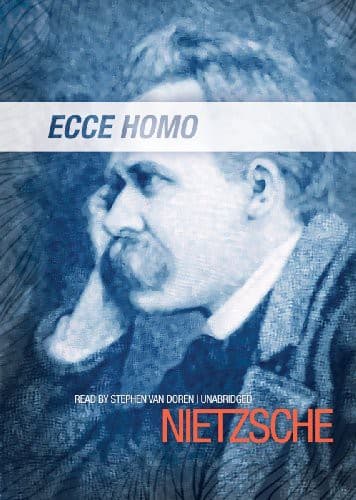
Ecce Homo: Complete Works, Volume SeventeenNietzsche, Friedrich Wilhelm
PhilosophyPhilosophy
Ecce Homo: Complete Works, Volume Seventeen
Nietzsche, Friedrich Wilhelm
Nietzsche, Friedrich Wilhelm, 1844-1900; Philosophers -- Germany -- Biography
I am by far the most terrible man that has ever existed; but this does
not alter the fact that I shall become the most beneficent. I know the
joy of _annihilation_ to a degree which is commensurate with my power
to annihilate. In both cases I obey my Dionysian nature, which knows
not how to separate the negative deed from the saying of yea. I am the
first immoralist, and in this sense I am essentially the annihilator.
3
People have never asked me as they should have done, what the name
of Zarathustra precisely meant in my mouth, in the mouth of the
first immoralist; for that which distinguishes this Persian from all
others in the past is the very fact that he was the exact reverse
of an immoralist. Zarathustra was the first to see in the struggle
between good and evil the essential wheel in the working of things.
The translation of morality into the realm of metaphysics, as force,
cause, end-in-itself, is his work. But the very question suggests
its own answer. Zarathustra created this most portentous of all
errors,--morality; therefore he must be the first to expose it. Not
only because he has had longer and greater experience of the subject
than any other thinker,--all history is indeed the experimental
refutation of the theory of the so-called moral order of things,--but
because of the more important fact that Zarathustra was the most
truthful of thinkers. In his teaching alone is truthfulness upheld as
the highest virtue--that is to say, as the reverse of the cowardice
of the "idealist" who takes to his heels at the sight of reality.
Zarathustra has more pluck in his body than all other thinkers put
together. To tell the truth and to aim straight: that is the first
Persian virtue. Have I made myself clear? ... The overcoming of
morality by itself, through truthfulness, the moralist's overcoming of
himself in his opposite--in me--that is what the name Zarathustra means
in my mouth.
4
Public-domain text, read in full here on John Shaqi.
Reviews
Reviews
No reviews yet
Be the first to share your thoughts on this work.
Elsewhere in the archive
Join the Discussion
Join the discussion
Sign in to leave a comment or review.
Sign InorCreate an account