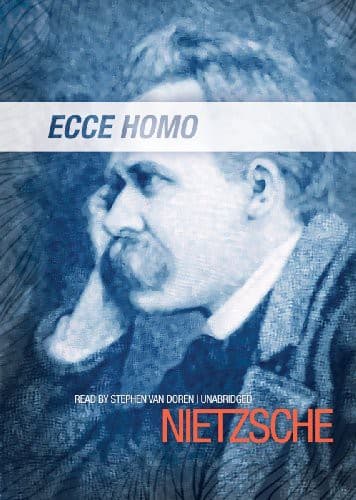
Ecce Homo: Complete Works, Volume SeventeenNietzsche, Friedrich Wilhelm
PhilosophyPhilosophy
Ecce Homo: Complete Works, Volume Seventeen
Nietzsche, Friedrich Wilhelm
Nietzsche, Friedrich Wilhelm, 1844-1900; Philosophers -- Germany -- Biography
In reality two negations are involved in my title Immoralist. I first
of all deny the type of man that has hitherto been regarded as the
highest--the _good,_ the _kind,_ and the _charitable_; and I also
deny that kind of morality which has become recognised and paramount
as morality-in-itself--I speak of the morality of decadence, or, to
use a still cruder term, Christian morality. I would agree to the
second of the two negations being regarded as the more decisive, for,
reckoned as a whole, the overestimation of goodness and kindness seems
to me already a consequence of decadence, a symptom of weakness, and
incompatible with any ascending and yea-saying life. Negation and
annihilation are inseparable from a yea-saying attitude towards life.
Let me halt for a moment at the question of the psychology of the
good man. In order to appraise the value of a certain type of man, the
cost of his maintenance must be calculated,--and the conditions of his
existence must be known. The condition of the existence of the _good_
is falsehood: or, otherwise expressed, the refusal at any price to
see how reality is actually constituted. The refusal to see that this
reality is not so constituted as always to be stimulating beneficent
instincts, and still less, so as to suffer at all moments the intrusion
of ignorant and good-natured hands. To consider distress of all kinds
as an objection, as something which must be done away with, is the
greatest nonsense on earth; generally speaking, it is nonsense of the
most disastrous sort, fatal in its stupidity--almost as mad as the will
to abolish bad weather, out of pity for the poor, so to speak. In the
great economy of the whole universe, the terrors of reality (in the
passions, in the desires, in the will to power) are incalculably more
necessary than that form of petty happiness which is called "goodness";
it is even needful to practise leniency in order so much as to allow
the latter a place at all, seeing that it is based upon a falsification
of the instincts. I shall have an excellent opportunity of showing the
incalculably calamitous consequences to the whole of history, of the
credo of optimism, this monstrous offspring of the _homines optimi._
Zarathustra,[1] the first who recognised that the optimist is just as
degenerate as the pessimist, though perhaps more detrimental, says:
"_Good men never speak the truth. False shores and false harbours
were ye taught by the good. In the lies of the good were ye born and
bred. Through the good everything hath become false and crooked from
the roots._" Fortunately the world is not built merely upon those
instincts which would secure to the good-natured herd animal his paltry
happiness. To desire everybody to become a "good man," "a gregarious
animal," "a blue-eyed, benevolent, beautiful soul," or--as Herbert
Spencer wished--a creature of altruism, would mean robbing existence of
its greatest character, castrating man, and reducing humanity to a sort
Public-domain text, read in full here on John Shaqi.
Reviews
Reviews
No reviews yet
Be the first to share your thoughts on this work.
Elsewhere in the archive
Join the Discussion
Join the discussion
Sign in to leave a comment or review.
Sign InorCreate an account