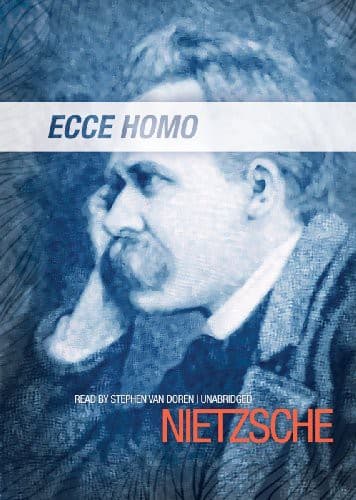
Ecce Homo: Complete Works, Volume SeventeenNietzsche, Friedrich Wilhelm
PhilosophyPhilosophy
Ecce Homo: Complete Works, Volume Seventeen
Nietzsche, Friedrich Wilhelm
Nietzsche, Friedrich Wilhelm, 1844-1900; Philosophers -- Germany -- Biography
But I have chosen the title of Immoralist as a surname and as a badge
of honour in yet another sense; I am very proud to possess this name
which distinguishes me from all the rest of mankind. No one hitherto
has felt Christian morality beneath him; to that end there were needed
height, a remoteness of vision, and an abysmal psychological depth, not
believed to be possible hitherto. Up to the present Christian morality
has been the Circe of all thinkers--they stood at her service. What
man, before my time, had descended into the underground caverns from
out of which the poisonous fumes of this ideal--of this slandering
of the world--burst forth? What man had even dared to suppose that
they were underground caverns? Was a single one of the philosophers
who preceded me a psychologist at all, and not the very reverse of a
psychologist--that is to say, a "superior swindler," an "Idealist"?
Before my time there was no psychology. To be the first in this new
realm may amount to a curse; at all events, it is a fatality: _for one
is also the first to despise._ My danger is the loathing of mankind.
7
Have you understood me? That which defines me, that which makes me
stand apart from the whole of the rest of humanity, is the fact that
I _unmasked_ Christian morality. For this reason I was in need of a
word which conveyed the idea of a challenge to everybody. Not to have
awakened to these discoveries before, struck me as being the sign
of the greatest uncleanliness that mankind has on its conscience,
as self-deception become instinctive, as the fundamental will to
be blind to every phenomenon, all causality and all reality; in
fact, as an almost criminal fraud _in psychologicis._ Blindness in
regard to Christianity is the essence of criminality--for it is the
crime _against_ life. Ages and peoples, the first as well as the
last, philosophers and old women, with the exception of five or six
moments in history (and of myself, the seventh), are all alike in
this. Hitherto the Christian has been _the_ "moral being," a peerless
oddity, and, _as_ "a moral being," he was more absurd, more vain, more
thoughtless, and a greater disadvantage to himself, than the greatest
despiser of humanity could have deemed possible. Christian morality
is the most malignant form of all false too the actual Circe of
humanity: that which has corrupted mankind. It is not error as error
which infuriates me at the sight of this spectacle; it is not the
millenniums of absence of "goodwill," of discipline, of decency, and
of bravery in spiritual things, which betrays itself in the triumph of
Christianity; it is rather the absence of nature, it is the perfectly
ghastly fact that _anti-nature_ itself received the highest honours as
morality and as law, and remained suspended over man as the Categorical
Imperative. Fancy blundering in this way, _not_ as an individual,
_not_ as a people, but as a whole species! as _humanity_! To teach the
Public-domain text, read in full here on John Shaqi.
Reviews
Reviews
No reviews yet
Be the first to share your thoughts on this work.
Elsewhere in the archive
Join the Discussion
Join the discussion
Sign in to leave a comment or review.
Sign InorCreate an account