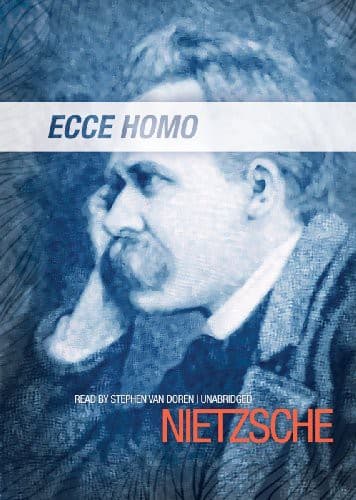
Ecce Homo: Complete Works, Volume SeventeenNietzsche, Friedrich Wilhelm
PhilosophyPhilosophy
Ecce Homo: Complete Works, Volume Seventeen
Nietzsche, Friedrich Wilhelm
Nietzsche, Friedrich Wilhelm, 1844-1900; Philosophers -- Germany -- Biography
of wretched Chinadom. _And this some have tried to do! It is precisely
this that men called morality._ In this sense Zarathustra calls "the
good," now "the last men," and anon "the beginning of the end"; and
above all, he considers them as _the most detrimental kind of men,_
because they secure their existence at the cost of Truth and at the
cost of the Future.
"The good--they cannot create; they are ever the beginning of the end.
"They crucify him who writeth new values on new tables; they sacrifice
_unto themselves_ the future; they crucify the whole future of humanity!
"The good--they are ever the beginning of the end.
"And whatever harm the slanderers of the world may do, _the harm of the
good is the most calamitous of all harm._"
5
Zarathustra, as the first psychologist of the good man, is perforce the
friend of the evil man. When a degenerate kind of man has succeeded
to the highest rank among the human species, his position must have
been gained at the cost of the reverse type--at the cost of the strong
man who is certain of life. When the gregarious animal stands in
the glorious rays of the purest virtue, the exceptional man must be
degraded to the rank of the evil. If falsehood insists at all costs on
claiming the word "truth" for its own particular standpoint, the really
truthful man must be sought out among the despised. Zarathustra allows
of no doubt here; he says that it was precisely the knowledge of the
good, of the "best," which inspired his absolute horror of men. And
it was out of this feeling of repulsion that he grew the wings which
allowed him to soar into remote futures. He does not conceal the fact
that his type of man is one which is relatively superhuman--especially
as opposed to the "good" man, and that the good and the just would
regard his superman as the _devil._
"Ye higher men, on whom my gaze now falls, this is the doubt that ye
wake in my breast, and this is my secret laughter: methinks ye would
call my Superman--the devil! So strange are ye in your souls to all
that is great, that the Superman would be terrible in your eyes for his
goodness."
It is from this passage, and from no other, that you must set out to
understand the goal to which Zarathustra aspires--the kind of man that
he conceives sees reality _as it is;_ he is strong enough for this--he
is not estranged or far removed from it, he is that reality himself, in
his own nature can be found all the terrible and questionable character
of reality: _only thus can man have greatness._
6
Public-domain text, read in full here on John Shaqi.
Reviews
Reviews
No reviews yet
Be the first to share your thoughts on this work.
Elsewhere in the archive
Join the Discussion
Join the discussion
Sign in to leave a comment or review.
Sign InorCreate an account