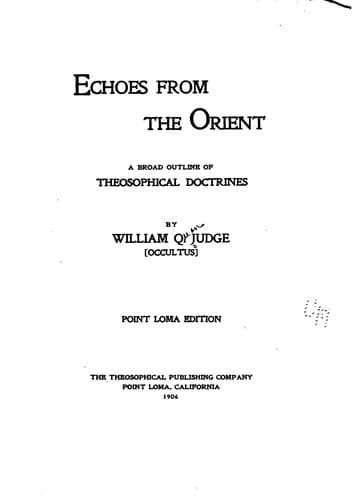
Echoes From The Orient: A Broad Outline of Theosophical DoctrinesJudge, William Quan
Religion
Echoes From The Orient: A Broad Outline of Theosophical Doctrines
Judge, William Quan
Theosophy
In this parentless and eternal space is the wheel in the center where
the Lipika are, of whom I cannot speak; at the four angles are the Dhyan
Chôhans, and doing their will among men on this earth are the
Adepts--the Mahâtmas. The harmony of the spheres is the voice of the
Law, and that voice is obeyed alike by the Dhyan Chôhan and the
Mahâtma--on their part with willingness, because they are the law; on
the part of men and creatures because they are bound by the adamantine
chains of the law which they do not understand.
When I said that nothing could be spoken about the Lipika, I meant that,
because of their mysterious nature and incomprehensible powers, it is
not possible to know enough to say anything with either sense or
certainty. But of the Dhyan Chôhans and the Adepts we may know
something, and are often given, as it were, tangible proof of their
existence. For the Adepts are living men, using bodies similar to ours;
they are scattered all over the earth in all nations; they know each
other, but not according to mere forms and Masonic signs of recognition,
unless we call natural, physical, and astral signs Masonic. They have
times when they meet together and are presided over by some among their
number who are more advanced in knowledge and power than the rest; and
these higher Adepts again have their communications, at which that One
who presides is the highest; from these latter begins the communication
with the Dhyan Chôhans. All in their several degrees do that work which
pertains to their degree, and although only to the Highest can be
ascribed any governance or guidance of nature and mankind, yet the very
least occupies an important place in the whole scheme. Freemasons and
the numerous mock-Rosicrucians of the day will probably not unanimously
accept this view, inasmuch as these Adepts have not submitted to their
ritual; but that there has always been a widespread--and, if you please,
a sometimes sneaking--belief in such beings and orders, is not difficult
to discern or prove.
VII.
An old argument for the existence of an extra-cosmic--a personal--God,
is this very intelligence that appears to pervade nature, from which the
conclusion is drawn that there is a being who is the intelligent
director. But Theosophy does not admit any such God, for he is neither
necessary nor possible. There are too many evidences of implacability in
the operations of nature for us to be able for very long to cherish the
notion of a personal God. We see that storms will rage and overwhelm
good and bad together; that earthquakes have no respect for age, sex or
rank, and that wherever a natural law has to act it will do so
regardless of human pain or despair.
Public-domain text, read in full here on John Shaqi.
Reviews
Reviews
No reviews yet
Be the first to share your thoughts on this work.
Join the Discussion
Join the discussion
Sign in to leave a comment or review.
Sign InorCreate an account