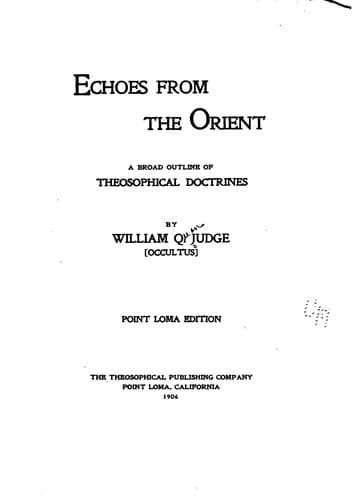
Echoes From The Orient: A Broad Outline of Theosophical DoctrinesJudge, William Quan
Religion
Echoes From The Orient: A Broad Outline of Theosophical Doctrines
Judge, William Quan
Theosophy
In the early days of the Theosophical Society the name Mahâtma was not
in use here, but the title then was "Brothers." This referred to the
fact that they were a band of men who belonged to a brotherhood in the
East. The most wonderful powers and, at times, the most extraordinary
motives were attributed to them by those who believed in their
existence.
They could pass to all parts of the world in the twinkling of an eye.
Across the great distance that India is from here they could precipitate
letters to their friends and disciples in New York. Many thought that if
this were done it was only for amusement; others looked at it in the
light of a test for the faithful, while still others often supposed
Mahâtmas acted thus for pure love of exercising their power. The
Spiritualists, some of whom believed that Mme. Blavatsky really did the
wonderful things told of her, said that she was only a medium, pure and
simple, and that her Brothers were familiar spooks of séance rooms.
Meanwhile the press in general laughed, and Mme. Blavatsky and her
Theosophical friends went on doing their work and never gave up their
belief in the Brothers, who after a few years came to be called
Mahâtmas. Indiscriminately with Mahâtma the word Adept has been used to
describe the same beings, so that we have these two titles made use of
without accuracy and in a misleading fashion.
The word Adept signifies proficiency, and is not uncommon, so that, when
using it, some description is necessary if it is to be applied to the
Brothers. For that reason I used Theosophical Adepts in a previous
paper. A Mahâtma is not only an Adept, but much more. The etymology of
it will make the matter clearer, the word being strictly Sanskrit, from
_mahâ_, great, and _âtmâ_, soul--hence Great Soul. This does not mean a
noble-hearted man merely, but a perfected being, one who has attained to
the state often described by mystics and held by scientific men to be an
impossibility, when time and space are no obstacles to sight, to action,
to knowledge or to consciousness. Hence they are said to be able to
perform the extraordinary feats related by various persons, and also to
possess information of a decidedly practical character concerning the
laws of nature, including that mystery for science--the meaning,
operation and constitution of life itself--and concerning the genesis of
this planet as well as the races upon it. These large claims have given
rise to the chief complaint brought forward against the Theosophical
Adepts by those writers outside of the Society who have taken the
subject up--that they remain, if they exist at all, in a state of cold
and selfish quietude, seeing the misery and hearing the groans of the
world, yet refusing to hold out a helping hand except to a favored few;
possessing knowledge of scientific principles, or of medicinal
preparations, and yet keeping it back from learned men or wealthy
capitalists who desire to advance commerce while they turn an honest
penny.
Public-domain text, read in full here on John Shaqi.
Reviews
Reviews
No reviews yet
Be the first to share your thoughts on this work.
Join the Discussion
Join the discussion
Sign in to leave a comment or review.
Sign InorCreate an account