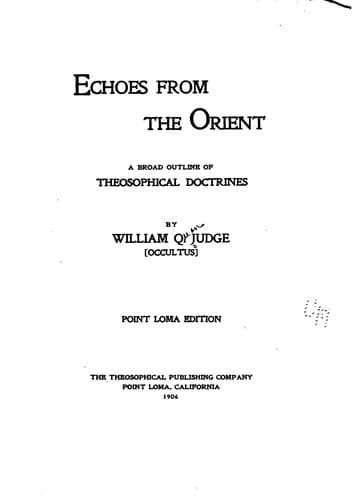
Echoes From The Orient: A Broad Outline of Theosophical Doctrines — John Shaqi
Echoes From The Orient: A Broad Outline of Theosophical DoctrinesJudge, William Quan
Religion
Echoes From The Orient: A Broad Outline of Theosophical Doctrines
Judge, William Quan
Theosophy
Hypnotism--though by another name--has long been known to them. The
hypnotic condition has often aided the schemes of priests and churches.
To compel recognition of true doctrine is not the way of these sages,
for compulsion is hypnotism. To feed a multitude with only five loaves
would be easy for them; but as they never act upon sentiment but
continually under the great cosmic laws, they do not advance with
present material aid for the poor in their hands. But, by using their
natural powers, they every day influence the world, not only among the
rich and poor of Europe and America, but in every other land, so that
what does come about in our lives is better than it would have been had
they not had part therein.
The other class referred to--Nirmânakâyas--constantly engage in this
work deemed by them greater than earthly enterprises: the betterment of
the soul of man, and any other good that they can accomplish through
human agents. Around them the long-disputed question of Nirvâna
revolves, for all that they have not been distinctly considered in it.
For, if Max Müller's view of Nirvâna, that it is annihilation, be
correct, than a Nirmânakâya is an impossibility. Paradoxically speaking,
they are in and out of that state at one and the same time. They are
owners of Nirvâna who refuse to accept it in order that they may help
the suffering orphan, Humanity. They have followed the injunction of the
_Book of the Golden Precepts_: "Step out from sunlight into shade, to
make more room for others."
A greater part is taken in the history of nations by the Nirmânakâyas
than anyone supposes. Some of them have under their care certain men in
every nation who from their birth are destined to be great factors in
the future. These they guide and guard until the appointed time. And
such protégés but seldom know that such influence is about them,
especially in the nineteenth century. Acknowledgment and appreciation of
such great assistance are not required by the Nirmânakâyas, who work
behind the veil and prepare the material for a definite end. At the same
time, too, one Nirmânakâya may have many different men--or women--whom
he directs. As Patanjali puts it, "In all these bodies one mind is the
moving cause."
Public-domain text, read in full here on John Shaqi.
Reviews
Reviews
No reviews yet
Be the first to share your thoughts on this work.
Join the Discussion
Join the discussion
Sign in to leave a comment or review.
Sign InorCreate an account