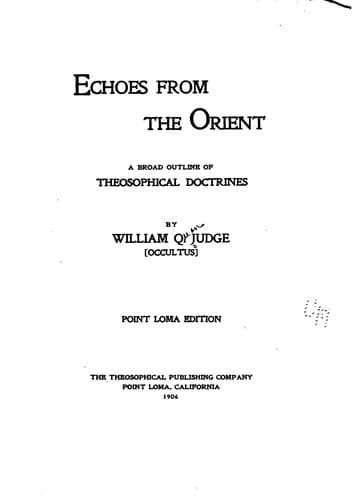
Echoes From The Orient: A Broad Outline of Theosophical DoctrinesJudge, William Quan
Religion
Echoes From The Orient: A Broad Outline of Theosophical Doctrines
Judge, William Quan
Theosophy
In the East the life of man is held to be a pilgrimage, not only from
the cradle to the grave, but also through that vast period of time,
embracing millions upon millions of years, stretching from the beginning
to the end of a Manvantara, or period of evolution, and as he is held to
be a spiritual being, the continuity of his existence is unbroken.
Nations and civilizations rise, grow old, decline and disappear; but the
being lives on, spectator of all the innumerable changes of environment.
Starting from the great All, radiating like a spark from the central
fire, he gathers experience in all ages, under all rulers, civilizations
and customs, ever engaged in a pilgrimage to the shrine from which he
came. He is now the ruler and now the slave; to-day at the pinnacle of
wealth and power, to-morrow at the bottom of the ladder, perhaps in
abject misery, but ever the same being. To symbolize this, the whole of
India is dotted with sacred shrines, to which pilgrimages are made, and
it is the wish of all men in that so-called benighted land to make such
a journey at least once before death, for the religious duties of life
are not fully performed without visiting such sacred places.
One great reason for this, given by those who understand the inner
significance of it, is that the places of pilgrimage are centers of
spiritual force from which radiate elevating influences not perceptible
to the pig-sticking, wine-drinking traveller. It is asserted by many,
indeed, that at most of the famous places of pilgrimage there is an
Adept of the same order to which the Theosophical Adepts are said to
belong, who is ready always to give some meed of spiritual insight and
assistance to those of pure heart who may go there. He, of course, does
not reveal himself to the knowledge of the people, because it is quite
unnecessary, and might create the necessity for his going elsewhere.
Superstitions have arisen from the doctrine of pilgrimages, but, as that
is quite likely to come about in this age, it is no reason why places of
pilgrimage should be abolished, since, if the spiritual centers were
withdrawn, good men who are free from superstition would not receive the
benefits they now may have. The Adepts founded these places in order to
keep alive in the minds of the people the soul idea which modern Science
and education would soon turn into agnosticism, were they to prevail
unchecked.
Public-domain text, read in full here on John Shaqi.
Reviews
Reviews
No reviews yet
Be the first to share your thoughts on this work.
Join the Discussion
Join the discussion
Sign in to leave a comment or review.
Sign InorCreate an account