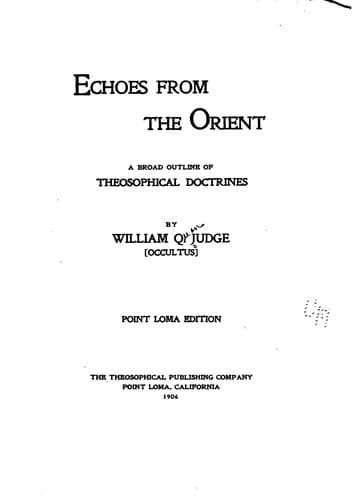
Echoes From The Orient: A Broad Outline of Theosophical Doctrines — John Shaqi
Echoes From The Orient: A Broad Outline of Theosophical DoctrinesJudge, William Quan
Religion
Echoes From The Orient: A Broad Outline of Theosophical Doctrines
Judge, William Quan
Theosophy
Were such doctrines held only in India, it would be natural to pass the
subject by with this brief mention. But when it is found that a large
body of people in America and Europe hold the same beliefs, it is
interesting to note such an un-Western development of thought. The
Theosophical Society was founded in New York in 1875, with the avowed
object of forming a nucleus for a Universal Brotherhood, and its
founders state that they believe the Indian Mahâtmas directed them to
establish such a society. Since its foundation it has gained members in
all countries, including people of wealth as well as those in moderate
circumstances, and the highly cultured also. Within its ranks there
flourish beliefs in the Mahâtmas of India and in Reïncarnation and its
twin doctrine, Karma. This last holds that no power, human or divine,
can save one from the consequences of acts performed, and that in this
life we are experiencing the results due to us for all acts and thoughts
which were ours in the preceding incarnation.
This has brought out a large body of literature in books and magazines
published in the United States, England, India, and elsewhere.
Newspapers are published in the interest of the new-old cult in the
vernacular of Hindûstan and also in old Ceylon. Even Japan has its
periodicals devoted to the same end, and to ignore so wide-spread a
movement would bespeak ignorance of the factors at work in our
development. When such an eminent authority as the great French savant,
Emile Burnouf, says that the Theosophical movement must be counted as
one of the three great religious influences in the world to-day, there
is no need of an excuse for presenting its features in detail to readers
imbued with the civilization of the West.
II.
In my former paper I merely hinted at the two principal doctrines
promulgated by the Theosophical Society; it is well now to notice the
fact that the Society itself was organized amid a shout of laughter,
which at intervals ever since has been repeated. Very soon after it
launched forth it found a new member in a Bavarian gentleman, Baron
Henry Louis de Palm, who not long thereafter died and obligingly left
his body to be cremated.
The funeral was held at Masonic Hall, New York city, and attracted
widespread attention from both press and public. It was Theosophical in
its character, and while conducted with befitting dignity in view of the
solemnity of the occasion, was along distinctly original lines. All this
of course, drew forth satire from the press, but served the purpose of
gaining some attention for the young Society. Its history since then has
been remarkable, and it is safe to say that no other similar body in
this century has drawn to itself so much consideration, stirred up such
a thinking among people on mystical subjects, and grown so rapidly amid
the loudest derision and against the fiercest opposition, within the
short space of fifteen years.
Public-domain text, read in full here on John Shaqi.
Reviews
Reviews
No reviews yet
Be the first to share your thoughts on this work.
Join the Discussion
Join the discussion
Sign in to leave a comment or review.
Sign InorCreate an account