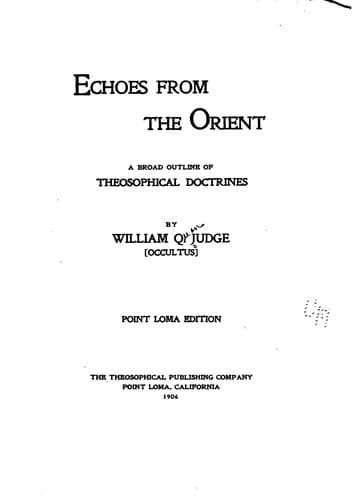
Echoes From The Orient: A Broad Outline of Theosophical DoctrinesJudge, William Quan
Religion
Echoes From The Orient: A Broad Outline of Theosophical Doctrines
Judge, William Quan
Theosophy
The Oriental doctrine of reward and punishment of the human Ego is very
different from the theological scheme accepted throughout Christendom,
since the Brahmins and Buddhists fix the place of punishment and
compensation upon this earth of ours, while the Christian removes the
"bar of God" to the hereafter. We may not profitably stop to argue upon
logic with the latter; it will be sufficient to quote to them the words
of Jesus, St. Matthew, and the Psalmist. "With what measure ye mete, it
shall be measured unto you again," said Jesus; and Matthew declares that
for every word, act, and thought we shall have to answer, while David,
the royal poet, sang that those who serve the Lord should never eat
beggar's bread. We all know well that the first two declarations do away
with the vicarious atonement; and as for the Jewish singer's notion, it
is negatived every day in any city of either hemisphere.
Among the Ceylonese Buddhists the name of the doctrine is Kamma; with
the Hindûs it is Karma. Viewed in its religious light, it "is the good
and bad deeds of sentient beings, by the infallible influence or
efficacy of which those beings are met with due rewards or punishment,
according as they deserve, in any state of being."[A] When a being dies,
he emits, as it were, a mass of force or energy, which goes to make up
the new personality when he shall be reïncarnated. In this energy is
found the summation of the life just given up, and by means of it the
Ego is forced to assume that sort of body among those appropriate
circumstances which together are the means for carrying out the decrees
of Karma.
Hence hell is not a mythical place or condition after death in some
unknown region specially set apart by the Almighty for the punishment of
his children, but is in very truth our own globe, for it is on the
earth, in earth-lives experienced in human bodies, that we are punished
for bad deeds previously done, and meet with happiness and pleasure as
rewards for old merit.
When one sees, as is so common, a good man suffering much in his life,
the question naturally arises, "Has Karma anything to do with it, and is
it just that such a person should be so afflicted?" For those who
believe in Karma it is quite just, because this man in a previous life
must have done such acts as deserve punishment now. And, similarly, the
wicked man who is free from suffering, happy and prosperous, is so
because in a previous existence he had been badly treated by his fellows
or had experienced much suffering. And the perfect justice of Karma is
well illustrated in his case because, although now favored by fortune,
he, being wicked, is generating causes which, when he shall be reborn,
will operate then to punish him for his evil-doing now.
Public-domain text, read in full here on John Shaqi.
Reviews
Reviews
No reviews yet
Be the first to share your thoughts on this work.
Join the Discussion
Join the discussion
Sign in to leave a comment or review.
Sign InorCreate an account