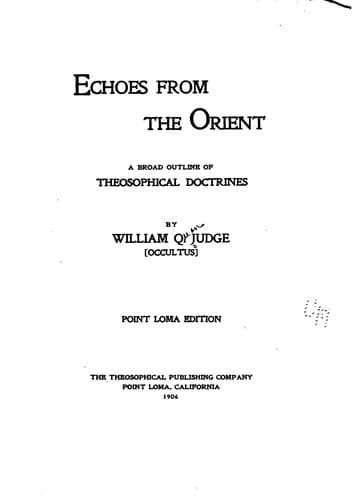
Echoes From The Orient: A Broad Outline of Theosophical DoctrinesJudge, William Quan
Religion
Echoes From The Orient: A Broad Outline of Theosophical Doctrines
Judge, William Quan
Theosophy
High in the esteem of the Hindû stands the serpent, both as a symbol and
a creature. Moving in a wavy line, he figures the vast revolution of the
Sun through eternal space carrying the rapidly whirling Earth in her
lesser orbit; periodically casting his skin, he presents a visible
illustration of renewal of life or reïncarnation; coiling to strike, he
shows the working of the law of Karma-Nemesis which, with a basis in our
actions, deals an unerring blow. As a symbol with tail in mouth, forming
a circle, he represents eternity, the circle of necessity, all-devouring
Time. For the older Initiates he spoke to them also of the astral light
which is at once devilish and divine.
Probably in the whole field of Theosophic study there is nothing so
interesting as the astral light. Among the Hindûs it is known as Akâsa,
which can also be translated as æther. Through a knowledge of its
properties they say that all the wonderful phenomena of the Oriental
Yogis are accomplished. It is also claimed that clairvoyance,
clairaudience, mediumship, and seership as known to the Western world
are possible only through its means. It is the register of our deeds and
thoughts, the great picture gallery of the earth, where the seer can
always gaze upon any event that has ever happened, as well as those to
come. Swimming in it as in a sea are beings of various orders and also
the astral remains of deceased men and women. The Rosicrucians and other
European mystics called these beings Sylphs, Salamanders, Gnomes,
Undines, Elementals; the Hindû calls them Gandharbhas or celestial
musicians, Yakshas, Rakshâsas and many more. The "spooks" of the
dead--mistaken by Spiritualists for the individuals who are no
more--float in this Akâsic substance, and for centuries have been known
to the mystical Hindû as Bhûta, another name for devil, or Pisâcha, a
most horrible devil; neither of them any more than the cast-off
soul-body nearest earth, devoid of conscience and only powerful for
evil.
Public-domain text, read in full here on John Shaqi.
Reviews
Reviews
No reviews yet
Be the first to share your thoughts on this work.
Join the Discussion
Join the discussion
Sign in to leave a comment or review.
Sign InorCreate an account