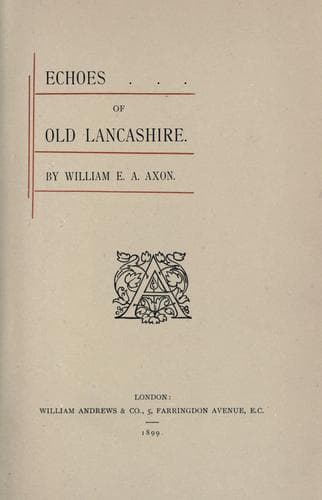
Echoes of Old LancashireAxon, William E. A. (William Edward Armytage)
History
Echoes of Old Lancashire
Axon, William E. A. (William Edward Armytage)
Lancashire (England) -- History
ground that the mills were adequate to the task of grinding all the
malt needed. The charge was fixed at “one shilling and no more for the
grinding of one load containing six bushels or twenty-four pecks of
malt of Winchester measure,” instead of the twenty-fourth part which
had previously been taken. The monopoly in this modified form continued
to our day.
Formerly the privilege was valuable, and though the profit was devoted
to a good cause, it is instructive to note the economical effect. The
restriction was always irksome to the brewers, and it is observable
that all modern local breweries have been erected just outside the
boundaries of the township of Manchester, as, for instance, in Moss
Side, Hulme, Cheetham, Ardwick, and Gorton. No new breweries have been
built for many years in Manchester proper.
It will be seen from this rapid retrospect that the Manchester Grammar
School Mills have a written history extending from the year 1301, and a
tradition that carries them generations further back.
The Rising of 1715.
England, it has been epigramatically said, is governed by reactions.
There is more truth in the remark than is usually found in smart
sayings. There is an ebb and flow in the political tide, the waves
which thunder against the bulwarks and threaten to overwhelm the
peaceful town beyond them, fall calmly back again to their sandy bed.
An example of this phenomenon we have in the intense Jacobitism of
Lancashire at the commencement of the last century. Lancashire was not
without gallant cavaliers who charged for the “King and the Laws”
behind the fiery Rupert, but the county at large swore by the
Parliament and struck some hard blows at the “Lord’s anointed.” The
memorable “petition for peace” was drawn up by a Manchester man, and
the first victims of that civil war which was to drench England with
blood, were inhabitants of that town. It was natural then to expect
that the pendulum should swing right to the other extreme of its line,
and that the descendants of those who had pulled down the monarch from
his throne, and consigned him to the traitor’s block, should be
sticklers for the right divine of kings to govern wrong, should risk
fortune, life, and limb, to replace on the throne of his ancestors the
double dealing James and his unfortunate descendants. There were some
special causes which strengthened the hands of the Jacobites in this
quarter. The Roman Catholics were distinguishable by their steady,
unalterable loyalty to the House of Stuart, and the persecution to
which they were subjected from the reign of Elizabeth downwards, only
served to strengthen their attachment. The jealousy of the Low Church
men, and the bitter antagonism of the Puritans was sufficient to defeat
any amelioration of their condition which the Sovereign might desire,
but in their sufferings they recollected that both Charles and his
brother had been desirous of extending to them toleration for the
Public-domain text, read in full here on John Shaqi.
Reviews
Reviews
No reviews yet
Be the first to share your thoughts on this work.
Elsewhere in the archive
Join the Discussion
Join the discussion
Sign in to leave a comment or review.
Sign InorCreate an account