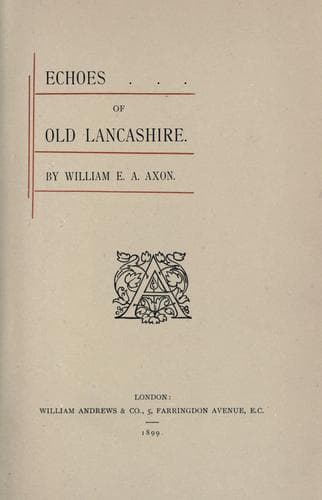
Echoes of Old LancashireAxon, William E. A. (William Edward Armytage)
History
Echoes of Old Lancashire
Axon, William E. A. (William Edward Armytage)
Lancashire (England) -- History
exercise of their religion. The Dissenters, however, chose to endure
the severities of the Test Act themselves, rather than do anything to
hinder the harrying and persecution of the Romanists. The Roman
Catholics had natural friends in the High Church men, who held in all
fulness the doctrine of the divine right, and consequently the
unlawfulness of the tenure by which King William and George I. held the
throne. The clearness and distinctness with which this opinion was
formulated must be considered if we would understand the motive power
of the Jacobite rebellions.
According to them the King was God’s representative on earth, and
unconditional obedience was due to all his commands. He might be a
drunken, licentious scoundrel, a perjured villain, a red-handed
murderer, a raving madman, but nothing on earth could invalidate his
inborn kingly right, and whoso disobeyed him, was false to God and to
his country. This opinion was supported by a second theory as to the
patriarchal origin of monarchy. Adam and Abraham exercised regal power,
therefore it was “unnatural for the people to govern or choose
governors.” Charles II. is but an odd looking patriarch, although like
the King of Yvetot, his subjects had a hundred reasons for calling him
their father. However, as the learned O’Flaherty in his “Ogygia” tells
us that the Stuarts were descended in a direct line from Adam (which is
probable), and that it was the 124th generation that ascended the
Scottish throne, Charles might perhaps claim his monarchical privileges
as heir general of the Father of Mankind.
This leading doctrine of the High Church party was closely wedded to a
sentiment of bitter dislike of the Protestant Dissenters. The
impeachment of Sacheverell, the High Church clergyman, for his
denunciation of the revolution of 1688, and of the principles which had
brought it about, roused to fever heat all the evil passions of the
time. His punishment (three years’ prohibition from preaching) was so
slight as to be almost a triumph. In 1714 a bill for the repression of
Schism was only prevented from coming in force by the death of Queen
Anne.
Public-domain text, read in full here on John Shaqi.
Reviews
Reviews
No reviews yet
Be the first to share your thoughts on this work.
Elsewhere in the archive
Join the Discussion
Join the discussion
Sign in to leave a comment or review.
Sign InorCreate an account