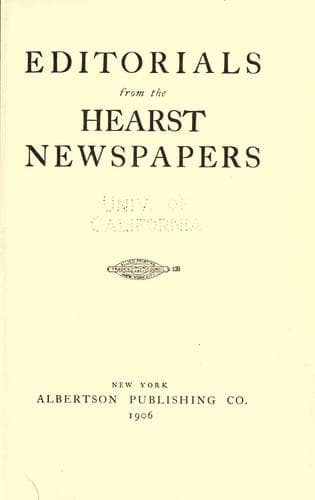
Editorials from the Hearst Newspapers — John Shaqi
Editorials from the Hearst NewspapersBrisbane, Arthur
Philosophy
Editorials from the Hearst Newspapers
Brisbane, Arthur
Editorials; Essays
Man, in his conquest and use of animal life, will run the gamut,
from the biggest elephant, employed as a public executioner in
India, to the invisible microbe, doing a work ten thousand times
more important all over the globe.
These infinitesimal microbes, bred and controlled by science,
will do regularly and methodically the work which buzzards and
vultures have done on land, which sharks and dogfish have done at
sea, throughout endless centuries.
To the marvellous workings of nature we cannot possibly give too
much thought or too great admiration. Gardens are filled with
beautiful flowers, and fields are fertile to-day because hundreds
of years ago sea birds were devouring the carcasses of dead fish,
acting as nature's scavengers, and building up the great guano
fields of South America.
There is a Peruvian millionaire in his big yacht, and there is a
rose in full bloom--the millionaire's money, the beauty of the
rose, come from those birds that picked up the dead fish five
hundred years ago.
It's an interesting world.
THE ELEPHANT THAT WILL NOT MOVE HAS BETTER EXCUSES THAN WE HAVE
FOR FOLLY DISPLAYED
This is an editorial which we shall merely suggest, and which
each reader will write out for himself.
In the Zoological Garden of New York a poor elephant has stood in
chains for years. The animal was thought to be vicious, and was
kept fastened tightly to one spot, that it might have no leeway
to do damage.
A short time ago its keeper became convinced that the elephant
would do no harm and might safely be unchained. The chains were
taken off, and the keeper thought with satisfaction that the poor
beast would now enjoy freedom and be made happy by the
possibility of moving freely about its large inclosure.
The elephant did not move. The chains were gone, it was no
longer tied, but it stood, and it still stands, in just the same
spot.
The habit of slavery, of monotony, had become too strong. The
elephant, though free, stands still, sadly swaying its heavy
head, ignorant of the freedom that has come to it.
Men and women and children who see the elephant, and other men
who write paragraphs for the newspapers, dilate on the poor
animal's "stupidity."
"The elephant has been called the most intelligent of animals,"
says one writer, "but this elephant, that doesn't know when the
chains are off, seems to prove that the elephant can be a good
deal of a fool."
How easy it is for us human beings to see the faults in others,
our fellows, and the animals below us.
But which one of us can truly say that he is not in exactly the
same position as that poor elephant, fixed to one spot by the
chains of long ago?
Are we not still standing as a race just as we stood years and
centuries ago, ignorant of the freedom that has come to us?
Thousands of splendid men have worked, lived and died to free us
from superstition, from credulity, from ignorance, yet still we
stand in the same place, and fail to appreciate the freedom that
is ours. ----
Public-domain text, read in full here on John Shaqi.
Reviews
Reviews
No reviews yet
Be the first to share your thoughts on this work.
Join the Discussion
Join the discussion
Sign in to leave a comment or review.
Sign InorCreate an account