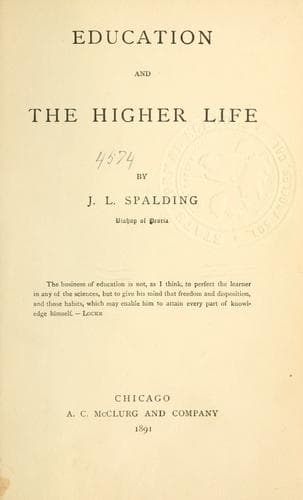
Education and the Higher LifeSpalding, John Lancaster
Religion
Education and the Higher Life
Spalding, John Lancaster
Education
"It takes a soul
To move a body; it takes a high-souled man
To move the masses ... even to a cleaner sty;
It takes the ideal to blow a hair's-breadth off
The dust of the actual--Ah, your Fouriers failed,
Because not poets enough to understand
That life develops from within."
He who believes in culture must believe in God; for what but God do we
mean when we talk of loving the best thoughts and the highest beauty? No
God, no best; but at most better and worse. And how shall a man's
delight in his growing knowledge not be blighted by a hidden taint, if
he is persuaded that at the core of the universe there is only blind
unconscious force? But if he believe that God is infinite power working
for truth and love, then can he also feel that in seeking to prepare his
mind for the perception of truth and his heart for the love of what is
good and fair, he is working with God, and moves along the way in which
his omnipotent hand guides heavenly spirits and all the countless
worlds. He desires that all men should be wiser and stronger and more
loving, even though he should be doomed to remain as he is, for then
they would have power to help him. He is certain of himself, and feels
no fear nor anger when his opinions are opposed. He learns to bear what
he cannot prevent, knowing that courage and patience make tolerable
immedicable ills. He feels no self-complacency, but rather the
self-dissatisfaction which comes of the consciousness of possessing
faculties which he can but imperfectly use. And this discontent he
believes to be the infinite God stirring within the soul. As the
earthquake which swallows some island in another hemisphere disturbs not
the even tenor of our way, so the passions of men whose world is other
than his, who dwell remote from what he contemplates and loves, shake
not his tranquil mind. While they threaten and pursue, his thought moves
in spheres unknown to them. He knows how little life at the best can
give, and is not hard to console for the loss of anything. There is no
true thought which he would not gladly make his own, even though it
should be the watchword of his enemies. Since morality is practical
truth, he understands that increasing knowledge will make it at once
more evident and more attractive. Hatred between races and nations he
holds to be not less unchristian than the hatred which arms the
individual against his fellow-man. It is impossible for him to be a
scoffer; for whatever has strengthened or consoled a human soul is
sacred in his eyes; and wherever there is question of what is socially
complex, as of a religion or a civilization, there is question of many
human lives, their hopes, their joys, their strivings, their yearnings,
disappointments, agonies, and deaths; and he is able to perceive that in
the ports of levity there is no refuge for hearts that mourn. Does not
love itself, in its heaven of bliss, turn away from him who mocks? The
Public-domain text, read in full here on John Shaqi.
Reviews
Reviews
No reviews yet
Be the first to share your thoughts on this work.
Elsewhere in the archive
Join the Discussion
Join the discussion
Sign in to leave a comment or review.
Sign InorCreate an account