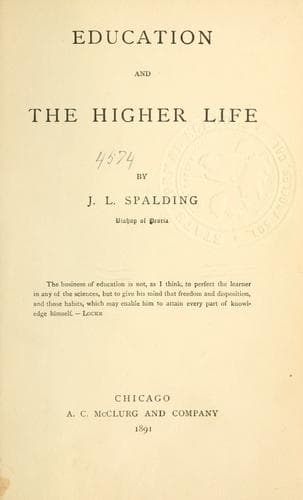
Education and the Higher LifeSpalding, John Lancaster
Religion
Education and the Higher Life
Spalding, John Lancaster
Education
lover of the intellectual life knows neither contempt nor indignation,
is not elated by success or cast down by failure; money cannot make him
rich, and poverty helps to make him free. His own experience teaches him
that men in becoming wiser will become nobler and happier; and this
sweet truth has in his eyes almost the elements of a religion. With
growing knowledge his power of sympathy is enlarged; until like Saint
Francis, he can call the sun his brother and the moon his sister; can
grieve with homeless winds, and feel a kinship with the clod. The very
agonies by which his soul has been wrung open to his gaze visions of
truth which else he had never caught, and so he finds even in things
evil some touch of goodness. Praise and blame are for children, but to
him impertinent. He is tolerant of absurdity because it is so
all-pervading that he whom it fills with indignation can have no repose.
While he labors like other men to keep his place in the world, he
strives to make the work whereby he maintains himself, and those who
cling to him, serve intellectual and moral ends. He has a meek and
lowly heart, and he has also a free and illumined mind, and a soul
without fear. He knows that no gift or accomplishment is incompatible
with true religion; for has not the Church intellects as many-sided and
as high as Augustine and Chrysostom, Dante and Calderon, Descartes and
Da Vinci, De Vega and Cervantes, Bossuet and Pascal, Saint Bernard and
Gregory the Seventh, Aquinas and Michael Angelo, Mozart and Fenelon? Ah!
I behold the youthful throng, happier than we, who here, in their own
sweet country,--in this city of government and of law with its wide
streets, its open spaces, its air of freedom and of light,--undisturbed
by the soul-depressing hum of commerce and the unintellectual din of
machinery, shall hearken to the voice of wisdom and walk in the pleasant
ways of knowledge, alive, in every sense, to catch whatever message may
come to them from God's universe; who, as they are drawn to what is
higher than themselves, shall be drawn together, like planets to a sun;
whose minds, aglow with high thinking, shall taste joy and delight
fresher and purer than merriest laughter ever tells. Who has not seen,
when leaden clouds fill the sky and throw gloomy shadows on the earth,
some little meadow amid the hills, with its trees and flowers, its
grazing kine and running brook, all bathed in sunlight, and smiling as
though a mother said, Come hither, darling?
Public-domain text, read in full here on John Shaqi.
Reviews
Reviews
No reviews yet
Be the first to share your thoughts on this work.
Elsewhere in the archive
Join the Discussion
Join the discussion
Sign in to leave a comment or review.
Sign InorCreate an account