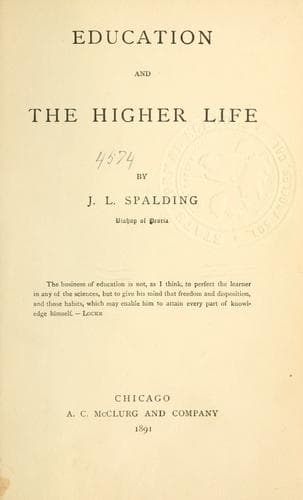
Education and the Higher LifeSpalding, John Lancaster
Religion
Education and the Higher Life
Spalding, John Lancaster
Education
Learning is acquaintance with what others have felt, thought, and done;
knowledge is the result of what we ourselves have felt, thought, and
done. Hence a man knows best what he has taught himself; what personal
contact with God, with man, and with Nature has made his own. The
important thing, then, is not so much to know the thoughts and loves of
others, as to be able ourselves to think truly, and to love nobly. The
aim should be to rouse, strengthen, and illumine the mind rather than to
store it with learning; and the great educational problem has been, and
is, how to give to the soul purity of intention, to the conscience
steadfastness, and to the mind force, pliability, and openness to light;
or in other words, how to bring philosophy and religion to the aid of
the will so that the better self shall prevail and each generation
introduce its successor to a higher plane of life.
To this end the efforts of all teachers have, with more or less
consciousness, tended; and in this direction too, along winding ways and
with periods of arrest or partial return, the race of man has for ages
been moving; and he who aspires to gain a place in the van of the mighty
army on its heavenward march,--
"And draw new furrows 'neath the healthy morn
And plant the great Hereafter in this Now,"--
may be rash, but his spirit is not ignoble. To him it may not be given
"to fan and winnow from the coming step of Time the chaff of custom;"
but if he persevere he may confidently hope that his thought and love
shall at length rise to fairer and more enduring worlds. He weds himself
to things of light, seeks aids to true life within, learns to live with
the noble dead, and with the great souls of the present who have uttered
the truth whereby they live, in a way more intimate and higher than that
granted to those who are with them day by day; for minds are not
separated by time and space, but by quality of thought. But to be able
to love this life, and with all one's heart to seek this close communion
with God, with noble souls, and with Nature is not easy, and it may be
that it is impossible for those who are not drawn to it by irresistible
instincts. For the intellect, at least, attractions are proportional to
destiny; and the art of intellectual life is not most surely learned by
those whom circumstances favor, but by those whom will impels onward to
exercise of mind; whom neither daily wants, nor animal appetites, nor
hope of gain, nor low ambition, nor sneers of worldlings, nor prayers of
friends, nor aught else can turn from the pursuit of wisdom; who, with
ceaseless labor and with patient thought, eat their way in silence, like
caterpillars, to the light, become their own companions, walk uplifted
by their own thoughts, and by slow and imperceptible processes are
transformed and grow to be the embodiment of the truth and beauty which
they see and love.
Public-domain text, read in full here on John Shaqi.
Reviews
Reviews
No reviews yet
Be the first to share your thoughts on this work.
Join the Discussion
Join the discussion
Sign in to leave a comment or review.
Sign InorCreate an account