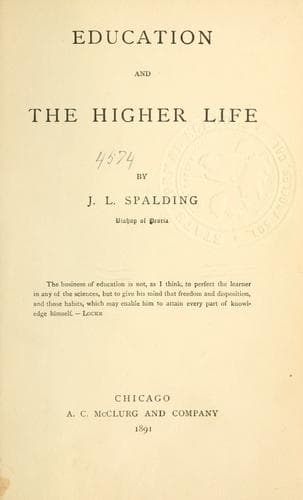
Education and the Higher LifeSpalding, John Lancaster
Religion
Education and the Higher Life
Spalding, John Lancaster
Education
Without a free and open mind there is no high and glad human life. You
may as well point to the savage drowsing in his tent, or to cattle
knee-deep in clover, and bid me think them high, as to ask me to admire
where I can behold neither intelligence nor love. All that we possess is
qualified by what we are. Gold makes not the miser rich, nor its lack a
true man poor; and he who has gained insight into the fair truth that he
is a part of all he sees and loves, is richer than kings, and lives like
a god in his universe. Possibilities for us are measured by the kind of
work in which we put our hearts. If a man's thoughts are wholly busy
with carpentering do not expect him to become anything else than a
carpenter; but if his aim is to build up his own being, to make his mind
luminous, his heart tender and pure, his will steadfast, who but God
shall fix a limit beyond which he may not hope to go. Education, indeed,
cannot confer organic power; but it alone gives us the faculty to
perceive how infinitely wonderful and fair are man's endowments, how
boundless his inheritance, how full of deathless hope is that to which
he may aspire. Religion, philosophy, poetry, science,--all bring us into
the presence of an ideal of ceaseless growth toward an all-perfect
Infinite, dimly discerned and unapproachable, but which fascinates the
soul and haunts the imagination with its deep mystery, until what we
long for becomes more real than all that we possess, and yearning is our
highest happiness. Ah! who would throw a veil over the vision on which
young eyes rest when young hearts feel that ideal things alone are real?
Who would rob them of this divine principle of progress which makes
growth the best of life?
"Many are our joys
In youth; but oh, what happiness to live
When every hour brings palpable access
Of knowledge, when all knowledge is delight!"
In all ages, we know those made wise by experience, which teaches us to
expect little, whether of ourselves or others, have made the thoughts
and hopes of youth a jest, even as men have made religion a jest, having
nothing to offer us in compensation for its loss, but witticisms and
despair. This is the fatal fault of life, that when we have obtained
what is good,--as wealth, position, wife, and friends,--we lose all hope
of the best, and with our mockery discourage those who have ideal aims;
who, remembering how the soul felt in life's dawn, retain a sense of
God's presence in the world, to whom with growing faculties they aspire,
feeling that whatsoever point they reach, they still have something to
pursue. This is the principle of the diviner mind in all high and heroic
natures; this is the spring-head of deeds that make laws, of "thoughts
that enrich the blood of the world;" this is the power which gives to
resolve the force of destiny, and clothes the soul with the heavenliest
strength and beauty when it stands single and alone, of men abandoned
and almost of God.
Public-domain text, read in full here on John Shaqi.
Reviews
Reviews
No reviews yet
Be the first to share your thoughts on this work.
Join the Discussion
Join the discussion
Sign in to leave a comment or review.
Sign InorCreate an account