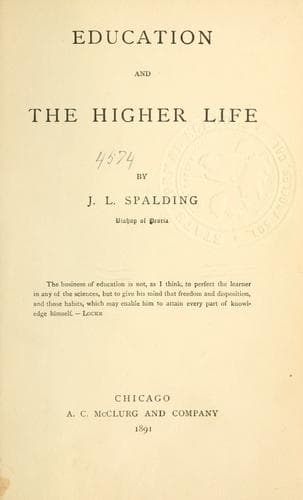
Education and the Higher LifeSpalding, John Lancaster
Religion
Education and the Higher Life
Spalding, John Lancaster
Education
With unresting, wearing thought and labor we are striving to make earth
more habitable. We drag forth from its inner parts whatever treasures
are hidden there; with steam's mighty force we mold brute matter into
every fair and serviceable form; we build great cities, we spread the
fabric of our trade; the engine's iron heart goes throbbing through
tunneled mountains and over storm-swept seas to bear us and our wealth
to all regions of the globe; we talk to one another from city to city,
and from continent to continent along ocean's oozy depths the lightning
flashes our words, spreading beneath our eyes each morning the whole
world's gossip,--but in the midst of this miraculous transformation, we
ourselves remain small, hard, and narrow, without great thoughts or
great loves or immortal hopes. We are a crowd where the highest and the
best lose individuality, and are swept along as though democracy were a
tyranny of the average man under which superiority of whatever kind is
criminal. Our population increases, our cities grow, our roads are
lengthened, our machinery is made more perfect, the number of our
schools is multiplied, our newspapers are read in ever-widening circles,
the spirit of humanity and of freedom breathes through our life; but the
individual remains common-place and uninteresting. He lacks
intelligence, has no perception of what is excellent, no faith in
ideals, no reverence for genius, no belief in any highest sort of man
who has not shown his worth in winning wealth, position, or notoriety.
We have a thousand poets and no poetry, a thousand orators and no
eloquence, a thousand philosophers and no philosophy. Every city points
to its successful men who have millions, but are themselves poor and
unintelligent; to its writers who, having sold their talent to
newspapers and magazines, sink to the level of those they address,
dealing only with what is of momentary interest, or if the question be
deep, they move on the surface, lest the many-eyed crowd lose sight of
them. The preacher gets an audience and pay on condition that he stoop
to the gossip which centres around new theories, startling events, and
mechanical schemes for the improvement of the country. If to get money
be the end of writing and preaching, then must we seek to please the
multitude who are willing to pay those who entertain and amuse them.
Will not our friends, even, conceive a mean opinion of our ability, if
we fail to gain public recognition?
Public-domain text, read in full here on John Shaqi.
Reviews
Reviews
No reviews yet
Be the first to share your thoughts on this work.
Join the Discussion
Join the discussion
Sign in to leave a comment or review.
Sign InorCreate an account