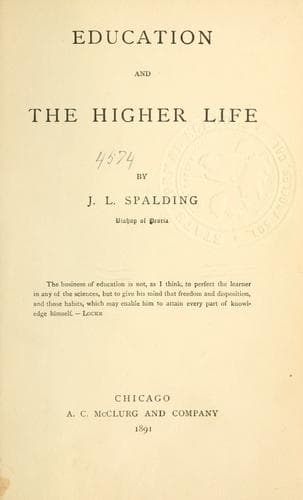
Education and the Higher LifeSpalding, John Lancaster
Religion
Education and the Higher Life
Spalding, John Lancaster
Education
What remains, then, but the ideal which I have proposed?--"Seek ye first
the Kingdom of God." Unless the light of Heaven fall along our way,
thick darkness gathers about us, and in the end, whatever our success
may have been, we fail, and are without God and without hope. So long
as any seriousness is left, religion is man's first and deepest concern;
to be indifferent is to be dull or depraved, and doubt is disease.
Difficulties assuredly there are, underlying not only faith, but all
systems of knowledge. How am I certain that I know anything? is a
question, debated in all past time, debatable in all future time; but we
are none the less certain that we know. The mind is governed by laws
which neither science nor philosophy can change, and while theories and
systems rise and pass away, the eternal problems present themselves ever
anew clothed in the eternal mystery. But little discernment is needed to
enable us to perceive how poor and symbolic are the thoughts of the
multitude. Half in pity, half in contempt, we rise to higher regions
only to discover that wherever we may be there also are the laws and the
limitations of our being; and that in whatsoever sanctuaries we may take
refuge, we are still of the crowd. We cannot grasp the Infinite;
language cannot express even what we know of the Divine Being, and hence
there remains a background of darkness, where it is possible to adore,
or to mock. But religion dispels more mystery than it involves. With it,
there is twilight in the world; without it, night. We are in the world
to act, not to doubt. Leaving quibbles to those who can find no better
use for life, the wise, with firm faith in God and man, strive to make
themselves worthy to do brave and righteous work. Distrust is the last
wisdom a great heart learns; and noble natures feel that the generous
view is, in the end, the true view. For them life means good; they find
strength and joy in this wholesome and cheerful faith, and if they are
in error, it can never be known, for if death end all, with it knowledge
ceases. Perceiving this, they strive to gain spiritual insight, they
look to God; toward him they turn the current of their thought and love;
the unseen world of truth and beauty becomes their home; and while
matter flows on and breaks and remakes itself to break again, they dwell
in the presence of the Eternal, and become co-workers with the Infinite
Power which makes goodness good, and justice right. They love knowledge,
because God knows all things; they love beauty, because he is its
source; they love the soul, because it brings man into conscious
communion with him and his universe. If their ideal is poetical, they
catch in the finer spirit of truth which the poet breathes, the
fragrance of the breath of God; if it is scientific, they discover in
the laws of Nature the harmony of his attributes; if it is political and
social, they trace the principles of justice and liberty to him; if it
Public-domain text, read in full here on John Shaqi.
Reviews
Reviews
No reviews yet
Be the first to share your thoughts on this work.
Join the Discussion
Join the discussion
Sign in to leave a comment or review.
Sign InorCreate an account