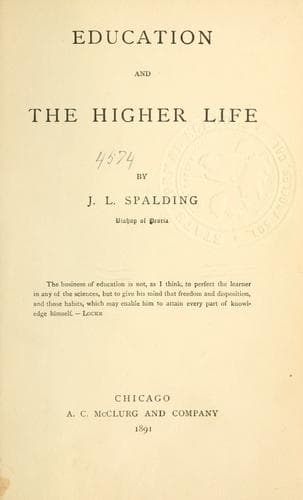
Education and the Higher LifeSpalding, John Lancaster
Religion
Education and the Higher Life
Spalding, John Lancaster
Education
Poetry is, as Aristotle says, the most philosophic of all writing. It is
also the writing which is most instinct with passion, with life. It
springs from intense thought and feeling, and bears within itself the
power to call forth thought and feeling. It is thought transfused with
the glow of emotion, and consequently thought made beautiful,
attractive, contagious. It is, to quote Wordsworth, "the breath and
finer spirit of all knowledge; it is the impassioned expression which is
in the countenance of all science." The poet has more enthusiasm and
tenderness than other men, a more sensitive soul, a more comprehensive
mind. His wider sympathy gives him greater insight; and his power to see
absent things as though they were present enables him to bring the
distant and the past before our eyes, to make them live again in a new
and immortal world; he stimulates the whole mind and appeals to every
faculty of the soul. The greatest philosophers are, like Plato, poets
too; and unless the historian is also a poet, there is no inspiration,
no life in what he writes. It is as superficial and vulgar to sneer at
poetry as to sneer at religion; and they alone are mockers who have eyes
but for some counterfeit. To be able to read a true poet is not a gift
of Nature; it is a faculty to be acquired. He creates, as Wordsworth
says, the taste by which he is appreciated. To imagine we may read him
as we read a frivolous novel is absurd; it may well happen we shall see
no truth or beauty in him until patient study has made it plain. It
often takes the world a hundred years or more to recognize a great poet;
and a knowledge of his worth can be had by the student only at the price
of patient labor. Wordsworth will attract scarcely any one at the first
glance; the great number of readers will soon weary of him and throw him
aside; but those who learn to understand him find in his writings
treasures above all price. There are but a few great poems in the
literatures of the different nations, but he who wishes to have a
cultivated mind must, at the cost of whatever time and labor, make
himself familiar with them; for there alone are found the best thoughts
clothed in fittest words; there alone are rightly portrayed the noblest
characters; there alone is the world of men and things transfigured by
the imagination and illumined by the pure light of the mind. True poets
help us to see, they teach us to admire, they lift our thoughts, they
appeal to our higher nature; they give us nobler loves, more exalted
aims, more spiritual purposes; they make us feel that to live for money
or place is to lead a narrow and a slavish life; and to men around whom
the fetters of material and hardening cares are growing, they cry and
bid them--
"Look abroad
And see to what fair countries they are bound."
Public-domain text, read in full here on John Shaqi.
Reviews
Reviews
No reviews yet
Be the first to share your thoughts on this work.
Join the Discussion
Join the discussion
Sign in to leave a comment or review.
Sign InorCreate an account