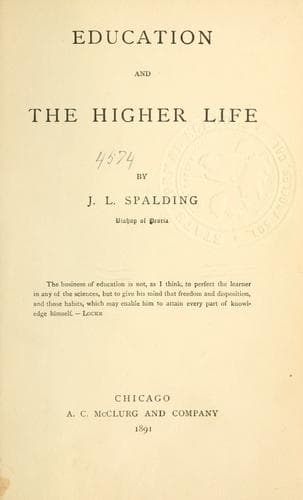
Education and the Higher LifeSpalding, John Lancaster
Religion
Education and the Higher Life
Spalding, John Lancaster
Education
But observant minds, however much they may love America, however great
their faith in popular government may be, cannot contemplate our actual
condition without a sense of disquietude; for there are aspects of our
social evolution which sadden and depress even the most patriotic and
loyal hearts. It would seem, for instance, that with us, while the
multitude are made comfortable and keen-witted, the individual remains
common-place and weak; so that on all sides people are beginning to ask
themselves what is the good of all this money and machinery if the race
of godlike men is to die out, or indeed if the result is not to be some
nobler and better sort of man than the one with whom we have all along
been familiar. Is not the yearning for divine men inborn? In the heroic
ages such men were worshiped as gods, and one of the calamities of
times of degeneracy is the dying out of faith in the worth of true
manhood caused by the disappearance of superior men. Such men alone are
memorable, and give to history its inspiring and educating power. The
ruins of Athens and Rome, the cathedrals and castles of Europe, uplift
and strengthen the heart, because they bid us reflect what thoughts and
hopes were theirs who thus could build.
How quickly kings and peasants, millionaires and paupers, become a
common, undistinguished crowd! But the hero, the poet, the saint, defy
the ages and remain luminous and separate like stars. They--
"Waged contention with their time's decay,
And of the past are all that cannot pass away."
The soul, which makes man immortal, has alone the power to make him
beneficent and beautiful.
But in this highest kind of man, in whom soul--that is, faith, hope,
love, courage, intellect--is supreme, we Americans, who are on the crest
of the topmost waves of the stream of tendency, are not rich. We have
our popular heroes; but so has every petty people, every tribe its
heroes. The dithyrambic prose in which it is the fashion to celebrate
our conspicuous men has a hollow sound, very like cant. A marvelous
development of wealth and numbers has taken place in America; but what
American--poet, philosopher, scientist, warrior, ruler, saint--is there
who can take his place with the foremost men of all this world? The
American people seem still to be somewhat in the position of our new
millionaires: their fortune is above them, overshadows, and oppresses
them. They live in fine houses, and have common thoughts; they have
costly libraries, and cheap culture; and their rich clothing poorly
hides their coarse breeding. Nor does the tendency seem to be toward a
nobler type of manhood.
Public-domain text, read in full here on John Shaqi.
Reviews
Reviews
No reviews yet
Be the first to share your thoughts on this work.
Join the Discussion
Join the discussion
Sign in to leave a comment or review.
Sign InorCreate an account