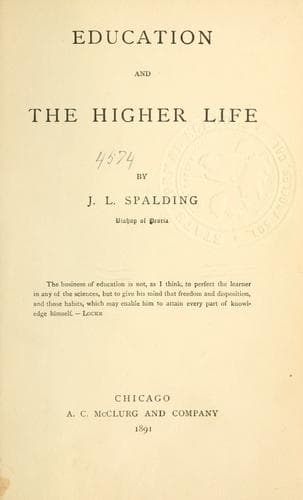
Education and the Higher LifeSpalding, John Lancaster
Religion
Education and the Higher Life
Spalding, John Lancaster
Education
They live in the midst of the excitement of ever-recurring elections, of
speculation, of financial schemes and commercial enterprises. It is an
unrestful, feverish, practical life, in which all the strong natures are
thinking of doing something, of gaining something,--a life in the
market-place, where high thought and noble conduct are all but
impossible, where the effort to make one's self a man, instead of
striving to get so many thousands of money, would seem ridiculous. It is
a life of inventions and manufactures, of getting and spending, in which
we bring forth and consume in a single century what it has taken Nature
many thousand years to hoard. Our aim is to have more rather than to be
more; our ideal is that of material progress; our praise is given to
those who invent and discover the means of augmenting wealth. Liberty is
opportunity to get rich; education is the development of the
money-getting faculty. Our national life may, of course, be looked at
from many sides, but the general drift of opinion and effort is in the
direction here pointed out. Nine tenths of our thought and energy are
given to material interests, and these interests represent nine tenths
of our achievements. This may be true of men in general, it may be true
also that material progress is a condition of moral and intellectual
growth; but none the less is it true that right human life is a life of
thought and love, of hope and faith, of imagination and desire.
Consequently in a well-ordered society, the chief aim--nine tenths of
all effort, let us say--will have for its object the creation of
enlightened and loving men and women, whom faith and hope shall make
strong, whom imagination shall refresh, and the desire of perfection
shall keep active. The aims which the ideals of democracy suggest are
not wholly or chiefly material. We strive, indeed, to create a social
condition in which comfort and plenty shall be within the reach of all;
but the better among us understand that this is but an inferior part of
our work, and they take no delight whatever in our great fortunes and
great cities. If democracy is the best government, it follows that it is
the kind of government which is most favorable to virtue, intelligence,
and religion. It is faint praise to say that in America there is more
enterprise, more wealth, than elsewhere. What we should strive to make
ourselves able to say, is, that there is here a more truly human life,
more public and private honesty, purity, sympathy, and helpfulness; more
love of knowledge, more perfect openness to light, greater desire to
learn, and greater willingness to accept truth than is to be found
elsewhere. It should be our endeavor to create a world of which it may
be said, there life is more pleasant, beauty more highly prized,
goodness held in greater reverence, the sense of honor finer, the
recognition of talent and worth completer than elsewhere.
Public-domain text, read in full here on John Shaqi.
Reviews
Reviews
No reviews yet
Be the first to share your thoughts on this work.
Elsewhere in the archive
Join the Discussion
Join the discussion
Sign in to leave a comment or review.
Sign InorCreate an account