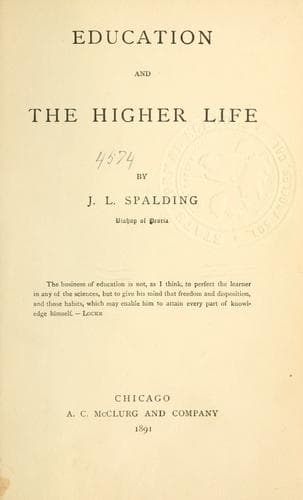
Education and the Higher LifeSpalding, John Lancaster
Religion
Education and the Higher Life
Spalding, John Lancaster
Education
As we can educate the faculties of thought and imagination, so can we
develop the power to love, to hope, to believe, and to desire. When
there is question of the intellect, teachers seek to impart information
rather than to strengthen the mind, and when there is question of the
moral nature, they have recourse to precepts and maxims instead of
striving to confirm the will and to direct impulse. It is generally
held, in fact, that will is a gift, not a growth, and the same view is
taken of all our moral dispositions. We are supposed to receive from
Nature a warm or a cold heart, a hopeful or a despondent temper, a
believing or a skeptical turn of mind, a spiritual or a sensual bent.
Now as I have already admitted, endowments are unlike; but what has this
to do with the drift of the argument? Minds, though by nature unequal,
may all be educated; and so wills may be educated, and so that which
makes us capable of faith, hope, and desire, may be drawn forth,
strengthened, and refined. Emerson, whose thought is predominantly
spiritual, takes a low and material view of the moral faculties,
confusing strength of will with health. "Courage," he says, "is the
degree of circulation of the blood in the arteries.... When one has a
plus of health, all difficulties vanish before it." But will is a moral
rather than a constitutional power; and in so far as it is moral, it
may be cultivated and directed to noble aims and ends. And if the
teacher perform this work with fine knowledge and tact, he becomes an
educator; for upon the will, more than upon the intellectual faculties,
success or failure depends. Whatever we are able to will, we are able to
learn to do; and the best service we can render another is to rouse and
confirm within him the will to live and to work, that he may make
himself a complete man, that thus he may become a benefactor of men and
a co-worker with God. The rational will, which is the educated will,
should give impulse and guidance to all our thinking, loving, and doing.
It should control appetite; it should nourish faith and hope; it should
lead us on through the illusory world of sensual delights, through the
hardly less illusory world of wealth and power, still bidding us look
and see that the world to which the conscious self really belongs, is
infinite and eternal, and that to seek to rest in aught else is to
apostatize from reason and conscience. Thus it would awaken in us a
divine discontent, a sacred unrest, which might urge us on through the
darkness of appetite and the unwholesome air of avarice and ambition,
whispering to us that our life-work is to know truth, to love beauty, to
do righteousness. To none is the education of the will so necessary as
to the lovers of intellectual excellence, for they who live in the world
of ideas are easily content to let the world of deeds take care of
itself. As the astronomer sees the earth lost like a grain of sand in
Public-domain text, read in full here on John Shaqi.
Reviews
Reviews
No reviews yet
Be the first to share your thoughts on this work.
Elsewhere in the archive
Join the Discussion
Join the discussion
Sign in to leave a comment or review.
Sign InorCreate an account