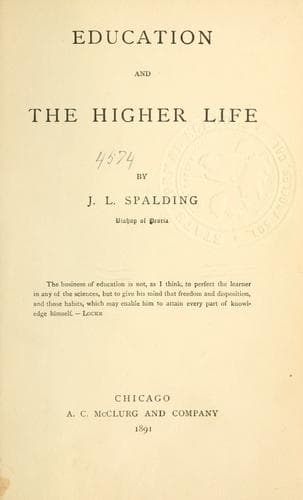
Education and the Higher LifeSpalding, John Lancaster
Religion
Education and the Higher Life
Spalding, John Lancaster
Education
love ourselves in the intellectual, moral, and religious life of the
race, which is a type and symbol of the infinite life of God, the omen
and promise of the soul's survival. As we become conscious of ourselves
only through communion with what is not ourselves, so we truly live only
when we live for God and the world he creates,--losing life that we may
find it; dying, like seed-corn, that we may rise to a new and richer
life. Not what gratifies our selfish or sensual nature will help us to
lead this right human life; but that which illumines and deepens thought
and love, which gives to faith a boundless scope, to hope an everlasting
foundation, to desire the infinite beauty which, though unseen, is felt,
like memory of music fled. The unseen world ceases to be a future
world; and is recognized as the very world in which we now think and
love, and so intellectual and moral life passes into the sphere of
religion. We no longer pursue ideals which forever elude us, but we
become partakers of the divine life; for in giving ourselves to the
Eternal and Infinite we find God in our souls. The ideal is made real;
God is with us, and through faith, hope, and love we are one with him,
and all is well. Henceforth in seeking to know more, to become more, we
are animated by a divine spirit. Now we may grow old, still learning
many things, still smitten with the love of beauty, still finding
delight in fresh thoughts and innocent pleasures, and it may be that we
shall be found to be teachers of wisdom and of holiness. Then, indeed,
shall we be happy, for it is better to teach truth than to win battles.
A war-hero supposes a barbarous condition of the race, and when all
shall be civilized, they who know and love the most shall be held to be
the greatest and the best.
CHAPTER VIII.
UNIVERSITY EDUCATION.
As they who look on the ocean think of its vastness; of the many shores
in many climes visited by its waves to ply "their priest-like task of
clean ablution;" of cities and empires that rose beside its waters,
flourished, decayed, and became a memory; of others that shall rise and
also pass away, while the moving element remains,--so we to-day
beholding ancient Faith, laying, in the New World, the cornerstone of an
institution which better than anything else symbolizes the aim and
tendency of modern life, find ourselves dwelling in thought upon what
has been and what will be.
Public-domain text, read in full here on John Shaqi.
Reviews
Reviews
No reviews yet
Be the first to share your thoughts on this work.
Elsewhere in the archive
Join the Discussion
Join the discussion
Sign in to leave a comment or review.
Sign InorCreate an account