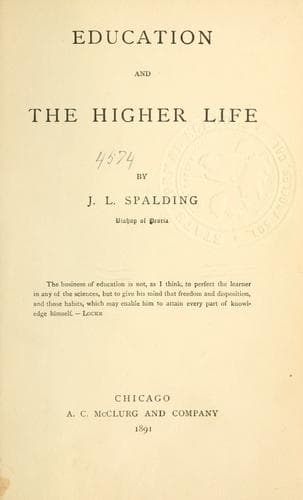
Education and the Higher LifeSpalding, John Lancaster
Religion
Education and the Higher Life
Spalding, John Lancaster
Education
Now, in all this, what do we perceive but the purpose of God, urging
mankind to wider and nobler life? History is his many-chambered school.
Here he has taught this lesson, and there another, still leading his
children out of the darkness of sin and ignorance toward the light of
righteousness and love, until his kingdom come, until his will be done
on earth as it is in heaven. To believe in God and in this divine
education, and to make co-operation with his providential guidance of
the race a life-aim is to have an ideal which is not only the highest,
but which also blends all other true ideals into harmony. And the lovers
of culture should be the first to perceive that intellectual good is
empty, illusory, unless there be added to it the good of the heart, the
good of conscience. To live for the cultivation of one's mind, is, after
all, to live for one's self, and therefore out of harmony with the
eternal law which makes it impossible for us to find ourselves except in
what is not ourselves. "It is the capital fault of all cultivated men,"
says Goethe, "that they devote their whole energies to the carrying out
of a mere idea, and seldom or never to the realization of practical
good." Whatever may be said in praise of culture, of its power to make
its possessor at home in the world of the best thought, the purest
sentiment, the highest achievements of the race; of the freedom, the
mildness, the reasonableness of the temper it begets; of its aim at
completeness and perfection,--it is nevertheless true, that if it be
sought apart from faith in God and devotion to man, its tendency is to
produce an artificial and unsympathetic character. The primal impulse of
our nature is to action; and unless we can make our thought a kind of
deed, it seems to be vain and unreal; and unless the harmonious
development of all the endowments which make the beauty and dignity of
human life, give us new strength and will to work with God for the good
of men, sadness and a sense of failure fall upon us. To have a
cultivated mind, to be able to see things on many sides, to have wide
sympathy and the power of generous appreciation,--is most desirable, and
without something of all this, not only is our life narrow and
uninteresting, but our energy is turned in wrong directions, and our
very religion is in danger of losing its catholicity.
Public-domain text, read in full here on John Shaqi.
Reviews
Reviews
No reviews yet
Be the first to share your thoughts on this work.
Join the Discussion
Join the discussion
Sign in to leave a comment or review.
Sign InorCreate an account