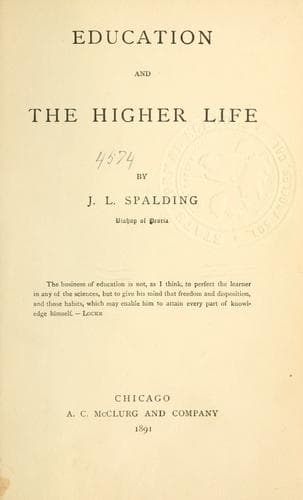
Education and the Higher LifeSpalding, John Lancaster
Religion
Education and the Higher Life
Spalding, John Lancaster
Education
But if like the old, the Church can look to the past, like the young,
she can look to the future. If there are Catholics who linger regretful
amid glories that have vanished, there are also Catholics who in the
midst of their work feel a confidence which leaves no place for regret;
who well understand that the earthly environment in which the Church
lives is subject to change and decay, and that new surroundings imply
new tasks and impose new duties. The splendor of the medieval Church,
its worldly power, the pomp of its ceremonial, the glittering pageantry
in which its pontiffs and prelates vied with kings and emperors in
gorgeous display, are gone, or going; and were it given to man to recall
the past, the spirit whereby it lived would still be wanting. But it is
the mark of youthful and barbarous natures to have eyes chiefly for the
garb and circumstance of religion, to see the body only and not the
soul. At all events the course of life is onward, and enthusiasm for the
past cannot become the source of great and far reaching action. The
present alone gives opportunity; and the face of hope turns to the
future, and the wise are busy with what lies at hand, with immediate
duty, and not with schemes for bringing back the things that have passed
away. Leaving their dead with the dead, they work for life and for the
living.
As in each individual there is a better and a worse self, so in each age
there are conflicting tendencies; but it is the part of enlightened
minds and generous hearts to see what is true, and to love what is good.
The fault-finder is hateful both in life and in literature; and it is
Iago, the most despicable of characters, whom Shakespeare makes say, "I
am nothing if not critical." A Christian of all men is without excuse
for being fretful and sour, for thinking and acting as though this were
a devil's world, and not the eternal God's, as though there were danger
lest the Almighty should not prevail. We know that God is, and therefore
that all will be well; and if it were conceivable that God is not, it
would still be the part of a true man to labor to make knowledge and
virtue prevail. The criticism of the age which gives a better
understanding of its needs is good; all other is baneful.
Public-domain text, read in full here on John Shaqi.
Reviews
Reviews
No reviews yet
Be the first to share your thoughts on this work.
Elsewhere in the archive
Join the Discussion
Join the discussion
Sign in to leave a comment or review.
Sign InorCreate an account