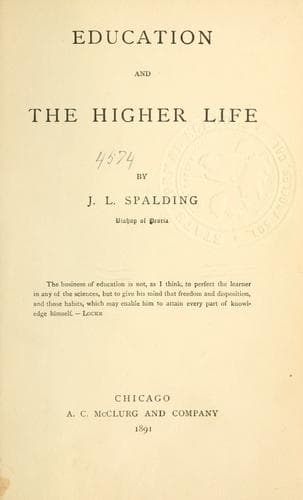
Education and the Higher LifeSpalding, John Lancaster
Religion
Education and the Higher Life
Spalding, John Lancaster
Education
Opinion rules the world, and a right appreciation of the influences by
which opinion is molded is the surest guide to a knowledge of the time.
In ignorant and barbarous ages the notions and beliefs of men are crude,
and are controlled by a few, for only a few possess knowledge and
influence; and even in the age of Pericles and Augustus, the thought of
mankind means the thoughts of some dozens of men. A few vigorous minds
founded schools of opinion and style, became intellectual dictators, and
asserted their authority for centuries. As the art of printing was yet
unknown, and books were rare, the teacher was the speaker; orators held
sway over the destiny of nations; and the Christian pulpit became the
world's university. But the printing-press in giving to thought a
permanent form which is placed under the eyes of the whole world has
made the passion, the splendor, the majestic phrase of oratory seem
unreal as an actor's speech, evanescent as a singer's tones; and hence
the pulpit and the rostrum, though they still have influence, can never
again exercise the control over opinion which belonged to them when all
men had not become readers.
What is true of eloquence may be affirmed of all art. In spite of
ourselves, even the best of us find it difficult to make art a serious
business; and unless taken seriously, it is vain, loses its soul, and
falls into the hands of pretenders and sentimentalists. Once painting,
sculpture, architecture, and song were the expression of thoughts and
moods which irresistibly appealed for utterance; but with us they are a
fashion, like cosmetics and laces. Poetry, the highest of arts, has lost
its original character of song, and the poet now deals, in an
imaginative way, with problems which puzzle metaphysicians and
theologians. The causes that have robbed art of so much of its charm and
power have necessarily diminished the influence of ceremonial worship,
which is the artistic expression of the soul's faith and love, of its
hopes and yearnings. We are, indeed, still subdued by the majesty of
dimly lighted cathedrals, by solemn music, and the various symbolism of
the ritual, but we feel not the deep awe of our fathers whose knees
furrowed the pavement stones, and whose burning lips kissed them smooth;
and to blame ourselves for this would serve no purpose. To those who
find no pleasure in sweet sounds, we pipe in vain, and argument to show
that one ought to be moved by what leaves him cold, is meaningless.
Emotion is spontaneous, and adorers, like lovers, neither ask nor care
for reasons. There is in fact an element of illusion in feeling; passion
is non-rational; and when the spirit of the time is intellectual, men
are seldom devout, however religious they may be. The scientific habit
of mind is not favorable to childlike and unreasoning faith; and the new
views of the physical universe which the modern mind is forced to take,
bring us face to face with new problems in religion and morals, in
Public-domain text, read in full here on John Shaqi.
Reviews
Reviews
No reviews yet
Be the first to share your thoughts on this work.
Elsewhere in the archive
Join the Discussion
Join the discussion
Sign in to leave a comment or review.
Sign InorCreate an account