"You must trust yourself. You say you know yourself too well? If you
feel so, you do _not_ know yourself; you know only the weak outer husk,
which has fallen often into the mire. But _you_--the real you--you are a
spark of God's own fire, and God, Who is almighty, is in you, and
because of that there is nothing that you cannot do if you will."
The teacher must feel that he has the power to teach his boys and to
train them for their future work in the world. This power is born of his
love for them and his desire to help them, and is drawn from the one
spiritual life of which all partake. It is because the teacher and his
boys are one in essence, make one little flame in "God's own fire," that
the teacher has the right to be confident that every effort to help,
growing out of his own share in the one life, will reach and stimulate
that same life in the boys.
He will not always be able to see at once the effect he is producing.
Indeed, the most important influence the teacher has shows itself in
the growing characters of the boys. No success in examinations, in
reports, in inspections can satisfy the real teacher as to the effect of
his work. But when he feels that his own higher nature is strengthened
and purified by his eagerness to serve his boys, when he has the joy of
watching the divine life in them shining out in answer to that in
himself, then his happiness is indeed great. Then he has the peace of
knowing that he has awakened in his boys the knowledge of their own
divinity, which, sooner or later, will bring them to perfection.
The teacher is justified in feeling confident because the divine life
is in him and his boys, and they turn to him for inspiration and
strength. Let him but send out to them all that is highest in himself,
and he may be quite sure that there will not be one boy who will not to
some extent respond in his own higher Self, however little the response
may be seen by the teacher.
This constant interplay of the one life between teacher and students
will draw them ever nearer to each other. They learn in the school to
live together as elder and younger brothers of the one school family.
By living a life of brotherhood within the small area of the school,
they will be trained to live that life in the larger area of the nation.
Then they will gradually learn that there is but one great brotherhood
in all the world, one divine life in all. This life each separate member
of the brotherhood is trying to express, consciously or unconsciously.
The teacher is indeed happy who knows his own divinity; that knowledge
of the divinity in man is the highest lesson it will ever be his
privilege to teach.
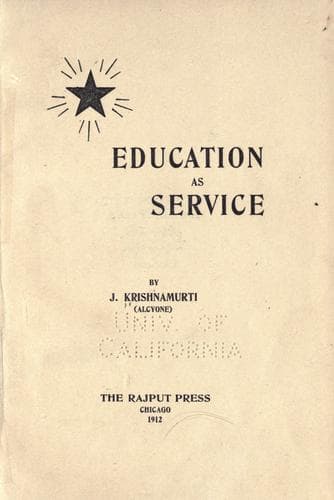
End of the Project Gutenberg EBook of Education as Service, by J. Krishnamurti
Public-domain text, read in full here on John Shaqi.
Reviews
Reviews
No reviews yet
Be the first to share your thoughts on this work.
Join the Discussion
Join the discussion
Sign in to leave a comment or review.
Sign InorCreate an account