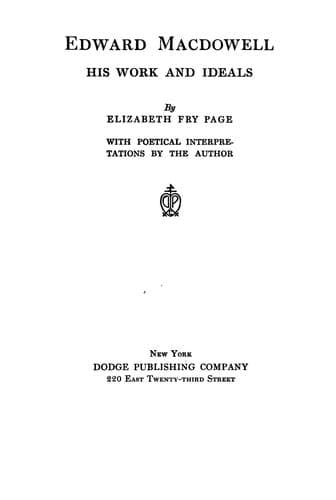
Edward MacDowell, His Work and IdealsPage, Elizabeth Fry
General
Edward MacDowell, His Work and Ideals
Page, Elizabeth Fry
MacDowell, Edward, 1860-1908
Universality is just now the philosophical ideal, and it seems to me
that America, the composite nation, is the proper center from which
such a spirit should emanate. Why try to foster the limited local idea
with regard to music, or any artistic or intellectual pursuit? Why
encourage the production of distinctive American music in a country in
which there is not even a distinctive type of face or mode of speech?
Here is a Virginian, descended from an American Indian and an English
colonist, living next door to a Plymouth Rock Yankee whose husband is
a French Canadian. Across the street is a German-American born in the
Middle West, who is married to a Californian of Spanish lineage. My
cook is an African, yours is Chinese and perhaps your housemaid is
Scandinavian, your chauffeur Irish, and so on. Music, to be effective
in such a patchwork civilization as this, would have to be _simply
music_--universal, composite, international.
MacDowell has created a typical music, typical of _himself_, not of
any locality, and he wished it to be judged as _music_, not as
_American_ music, and the justice of his desire cannot be gainsaid.
Recalling all of the influences of inherited and natural temperament,
education, foreign environment and American experience, jealous as we
are of his genius, we must admit that he caught in his productions the
complexity of his time. His music is universal and reflects the genius
of his contemporaries, as well as that of the older masters,
impregnated with his individual creativeness. He had seeing eyes and
hearing ears, and realizing the eternal principle of rhythm and the
universality of tone, he caught the keynote of everything related to
him in the outer world, with its corresponding relation in the inner
or unseen realms, producing compositions that are complete in form,
accurate in intellectual grasp and spiritually prophetic.
He fashioned his own wreath of immortelles,
With matchless skill.
Tones lent themselves with subtle eagerness
To do his will.
Repeat them as his genius did design,
His pow'r devise;
No higher tribute to his name and fame
From us could rise.
POETICAL INTERPRETATIONS
By ELIZABETH FRY PAGE
TO MACDOWELL
Now, in the darkness, mute, from hour to hour,
Sits one who lov'd all life, and from the strings
Of well-tuned harp brought sounds of common things,
And sang of sea and wood and tree and flow'r.
His task all done, fled usefulness and pow'r,
Through the deep shade his uncurbed fancy wings,
While with his fame his proud land loudly rings,
And praise falls on his work in lavish show'r.
The rosemary we bring, and no rude hand
The laurel would withhold, the plaudits stay.
For him is seen the magic circled wand
That to creative genius points the way.
His music's bold, true note Time's test will stand.
His age in art begins with cloudless day.
A.D. 1620
Public-domain text, read in full here on John Shaqi.
Reviews
Reviews
No reviews yet
Be the first to share your thoughts on this work.
Join the Discussion
Join the discussion
Sign in to leave a comment or review.
Sign InorCreate an account