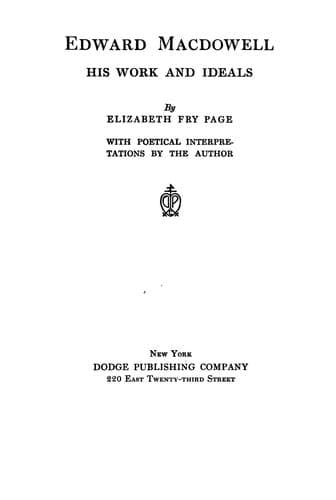
Edward MacDowell, His Work and IdealsPage, Elizabeth Fry
General
Edward MacDowell, His Work and Ideals
Page, Elizabeth Fry
MacDowell, Edward, 1860-1908
The work of MacDowell certainly has the characteristic vigor and
vividness, the unstudied activity, the unexpected leaps and springs
that the derivation of the word "caprice" suggests. And, if one cares
for mysticism, it is interesting to know that according to the
teachings of the ancient science of astrology, which is having a
considerable revival at present, the composer is entitled to
unconventional methods and an unusual combination of qualities, as he
was born on the cusp between the zodiacal signs of Sagittarius and
Capricornus. The latter sign produces people who will work well
independently, but are very restless when under orders or hampered by
rules and regulations. They love freedom, are fine entertainers, have
little self-esteem, are inclined to be either on the heights or in the
depths, are excellent musicians and lovers of harmony and beauty. They
are often victims of over-work because of the determination to make a
brilliant success of what they undertake and of their lack of judgment
in regard to their powers of endurance. Sagittarius people are
characterized by directness of speech and act. They are of varied
talents, very musical and turn naturally to the spiritual side of
life. They belong to the prophetic realm and see wonderful visions,
but are no idle dreamers, being always mentally and physically active.
Whatever there may be in the science of astrology, one who is familiar
with the life and character of Edward MacDowell cannot fail to be
impressed by the correctness of this delineation, so far as it goes.
But his style of composition is not, to my mind, capricious. It is the
result of many interesting influences of heredity, culture and
individual temperament and application. When he went to Paris, at
fifteen, he was a pupil of Marmontel in piano and of Savard in theory
and composition; but young as he was, the French school did not
satisfy him. He heard Nicholas Rubinstein play while in Paris, and
became fired with enthusiasm by his style and impressed with the idea
that in Germany he would find his own. His father was of Quaker
extraction and had decided artistic ability, but his pious parents
would not permit him to indulge even the thought of cultivating or
pursuing so trivial a calling. Edward inherited his father's talent,
and while in the French capital, during a period of despondency over
his slow progress with the language, he made a caricature of the
teacher of his French class on a leaf of his exercise book. In some
way it fell under the tutor's eye, and it was of such excellence that
it aroused new interest in the gifted hoy instead of indignation. The
teacher showed it to one of the leading artists in Paris, who implored
young MacDowell to leave off music and study art, assuring him that he
had unusual ability. But the lad also had a well-developed
discriminative faculty. He had chosen his ideal and could not he
persuaded to forsake it, preferring tone-pictures to those made with
brushes and palette.
Public-domain text, read in full here on John Shaqi.
Reviews
Reviews
No reviews yet
Be the first to share your thoughts on this work.
Join the Discussion
Join the discussion
Sign in to leave a comment or review.
Sign InorCreate an account