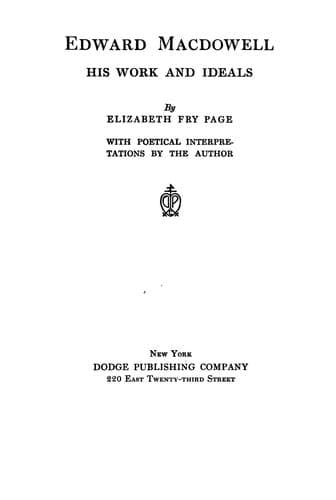
Edward MacDowell, His Work and IdealsPage, Elizabeth Fry
General
Edward MacDowell, His Work and Ideals
Page, Elizabeth Fry
MacDowell, Edward, 1860-1908
He is the first composer of world-note since Brahms who did his best
work for the piano. Others have used that instrument as a means
merely, reserving their crowning efforts for the orchestra, where it
is, of course, far less difficult to achieve fine effects. While he
wrote successful orchestral suites, he dignified the single instrument
by devoting his first thought to piano literature.
His humorous suite, "The Marionettes," very strongly suggests Jerome
K. Jerome's "Stageland," in which the villain is represented as an
individual who always wears a clean collar and smokes a cigarette. The
hero approaches the heroine from the rear and "breathes his attachment
down her back," and the poor heroine is pursued by the relentless
storm, while on the other side of the street the sun is shining.
MacDowell portrays the coquettish "Soubrette," the longing "Lover,"
the strong-charactered "Witch," the gay "Clown," the sinister
"Villain" and the simple, tender "Sweetheart," with a Prologue
indicating "sturdy good humor" and an Epilogue to be rendered
"musingly, with deep feeling." The suite is very attractive and in
sharp contrast to his romantic, heroic and lyric work.
Another potent factor in the formation of MacDowell's style of
composition was his love of nature. No one has put truer brooks,
birds, flowers, trees, meadows or sea into tone. Whenever he "loafed
and invited his soul," the tired, city-worn world reaped the benefit.
His lesser piano compositions may be, in a sense, considered in the
light of a diary. We are with him in a fisherman's hut, in deep woods,
on a deserted farm, in the haunted house, by the lily pond, in
mid-ocean, by a meadow brook, by smoldering embers, always seeing the
picture, hearing the voices or feeling the atmosphere that appealed to
his artist mind. The charm of common things, the ever-present beauty
and harmony in all forms of life, supplied him with endless
inspiration.
In portraying nature, he is in no sense a copyist. He does not
describe a scene, an occasion or an object, but suggests it, being an
adept in the use of musical metaphor. Robert Louis Stevenson says that
the one art in literature is to omit. "If I knew how to omit," says
he, "I should ask no other knowledge." Painters tell us that the
highest evidence of skill in transferring nature to canvas is to avoid
too much detail, and they squint up their eyes in order not to see too
much. These standards prove MacDowell the artist. He does not make the
mistake that so many preachers and public teachers do of presuming
upon the ignorance or stupidity of his hearers, but leaves something
to their imagination and inner artistic senses.
Public-domain text, read in full here on John Shaqi.
Reviews
Reviews
No reviews yet
Be the first to share your thoughts on this work.
Join the Discussion
Join the discussion
Sign in to leave a comment or review.
Sign InorCreate an account