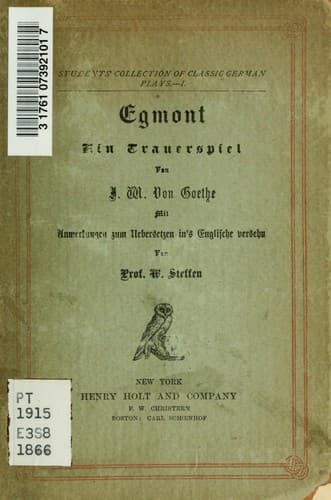
Egmont, Lamoraal, Graaf van, 1522-1568 -- Drama; Tragedies (Drama)
Egmont. No more of this. Man imagines that he directs his life, that
he governs his actions, when in fact his existence is irresistibly
controlled by his destiny. Let us not dwell upon this subject; these
reflections I can dismiss with ease--not so my apprehensions for these
provinces; yet they too will be cared for. Could my blood flow for many,
bring peace to my people, how freely should it flow! Alas! This may not
be. Yet it ill becomes a man idly to speculate, when the power to act
is no longer his. If thou canst restrain or guide the fatal power of thy
father; do so. Alas, who can?--Farewell!
Ferdinand. I cannot leave thee.
Egmont. Let me urgently recommend my followers to thy care! I have
worthy men in my service; let them not be dispersed, let them not become
destitute! How fares it with Richard, my secretary?
Ferdinand. He is gone before thee. They have beheaded him, as thy
accomplice in high treason.
Egmont. Poor soul!--Yet one word, and then farewell, I can no more.
However powerfully the spirit may be stirred, nature at length
irresistibly asserts her rights; and like a child, who, enveloped in
a serpent's folds, enjoys refreshing slumber, so the weary one lays
himself down to rest before the gates of death, and sleeps soundly, as
though a toilsome journey yet lay before him.--One word more,--I know
a maiden; thou wilt not despise her because she was mine. Since I can
recommend her to thy care, I shall die in peace. Thy soul is noble; in
such a man, a woman is sure to find a protector. Lives my old Adolphus?
Is he free?
Ferdinand. The active old man, who always attended thee on horseback?
Egmont. The same.
Ferdinand. He lives, he is free.
Egmont. He knows her dwelling; let him guide thy steps thither, and
reward him to his dying day, for having shown thee the way to this
jewel.--Farewell!
Ferdinand. I cannot leave thee.
Egmont (urging him towards the door). Farewell!
Ferdinand. Oh, let me linger yet a moment!
Egmont. No leave-taking, my friend.
(He accompanies Ferdinand to the door, and then tears himself away;
Ferdinand, overwhelmed with grief, hastily retires.)
Egmont (alone)
Egmont. Cruel man! Thou didst not think to render me this service
through thy son. He has been the means of relieving my mind from the
pressure of care and sorrow, from fear and every anxious feeling.
Gently, yet urgently, nature claims her final tribute. 'Tis past!--'Tis
resolved! And the reflections which, in the suspense of last night, kept
me wakeful on my couch, now with resistless certainty lull my senses to
repose.
(He seats himself upon the couch; music)
Sweet sleep! Like the purest happiness, thou comest most willingly,
uninvited, unsought. Thou dost loosen the knots of earnest thoughts,
dost mingle all images of joy and of sorrow, unimpeded the circle of
inner harmony flows on, and wrapped in fond delusion, we sink into
oblivion, and cease to be.
Public-domain text, read in full here on John Shaqi.
Reviews
Reviews
No reviews yet
Be the first to share your thoughts on this work.
Elsewhere in the archive
Join the Discussion
Join the discussion
Sign in to leave a comment or review.
Sign InorCreate an account