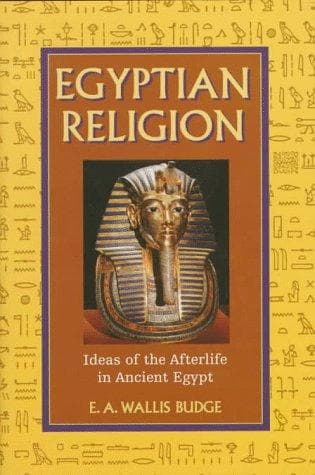
Egyptian Ideas of the Future LifeBudge, E. A. Wallis (Ernest Alfred Wallis), Sir
ReligionComparative
Egyptian Ideas of the Future Life
Budge, E. A. Wallis (Ernest Alfred Wallis), Sir
Egypt -- Religion; Eschatology, Egyptian; Future life
We have seen how R[=a] has become the visible type and symbol of God,
and the creator of the world and of all that is therein; we may now
consider the position which he held with, respect to the dead. As far
back as the period of the IVth dynasty, about B.C. 3700, he was regarded
as the great god of heaven, and the king of all the gods, and divine
beings, and of the beatified dead who dwelt therein. The position of the
beatified in heaven is decided by R[=a], and of all the gods there
Osiris only appears to have the power to claim protection for his
followers; the offerings which the deceased would make to R[=a] are
actually presented to him by Osiris. At one time the Egyptian's greatest
hope seems to have been that he might not only become "God, the son of
God," by adoption, but that R[=a] would become actually his father. For
in the text of Pepi I, [Footnote: Ed. Maspero, line 570.] it is said:
"Pepi is the son of R[=a] who loveth him; and he goeth forth and raiseth
himself up to heaven. R[=a] hath begotten Pepi, and he goeth forth and
raiseth himself up to heaven. R[=a] hath conceived Pepi, and he goeth
forth and raiseth himself up to heaven. R[=a] hath given birth, to
Pepi, and he goeth forth and raiseth himself up to heaven."
Substantially these ideas remained the same from the earliest to the
latest times, and R[=a] maintained his position as the great head of the
companies, notwithstanding the rise of Amen into prominence, and the
attempt to make Aten the dominant god of Egypt by the so-called "Disk
worshippers." The following good typical examples of Hymns to R[=a] are
taken from the oldest copies of the Theban Recension of the Book of the
Dead.
I. FROM THE PAPYRUS OF ANI. [Footnote: See _The Chapters of Coming Forth
by Day_, p. 3.]
"Homage to thee, O thou who hast come as Khepera, Khepera the creator
of the gods. Thou risest and thou shinest, and thou makest light to be
in thy mother Nut (_i.e._, the sky); thou art crowned king of the
gods. Thy mother Nut doeth an act of homage unto thee with both her
hands. The laud of Manu (_i.e._, the land where the sun sets)
receiveth thee with satisfaction, and the goddess Ma[=a]t embraceth
thee both, at morn and at eve. [Footnote: _i.e._, Ma[=a]t, the goddess
of law, order, regularity, and the like, maketh the sun to rise each
day in his appointed place and at his appointed time with absolute and
unfailing regularity.] Hail, all ye gods of the Temple of the Soul,
[Footnote: _i.e._, the soul referred to above in the account of the
creation; see p. 24.] who weigh heaven and earth in the balance, and
who provide divine food in abundance! Hail, Tatunen, thou One, thou
Creator of mankind and Maker of the substance of the gods of the south
and of the north, of the west and of the east! O come ye and acclaim
R[=a], the lord of heaven and the Creator of the gods, and adore ye
him in his beautiful form as he cometh in the morning in his divine
bark.
Public-domain text, read in full here on John Shaqi.
Reviews
Reviews
No reviews yet
Be the first to share your thoughts on this work.
Join the Discussion
Join the discussion
Sign in to leave a comment or review.
Sign InorCreate an account