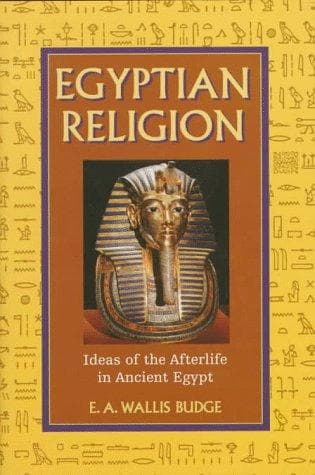
Egyptian Ideas of the Future LifeBudge, E. A. Wallis (Ernest Alfred Wallis), Sir
ReligionComparative
Egyptian Ideas of the Future Life
Budge, E. A. Wallis (Ernest Alfred Wallis), Sir
Egypt -- Religion; Eschatology, Egyptian; Future life
The Egyptians of every period in which they are known to us believed
that Osiris was of divine origin, that he suffered death and mutilation
at the hands of the powers of evil, that after a great struggle with
these powers he rose again, that he became henceforth the king of the
underworld and judge of the dead, and that because he had conquered
death the righteous also might conquer death; and they raised Osiris to
such an exalted position in heaven that he became the equal and, in
certain cases, the superior of R[=a], the Sun-god, and ascribed to him
the attributes which belong unto God. However far back we go, we find
that these views about Osiris are assumed to be known to the reader of
religious texts and accepted by him, and in the earliest funeral book
the position of Osiris in respect of the other gods is identical with
that which he is made to hold in the latest copies of the Book of the
Dead. The first writers of the ancient hieroglyphic funeral texts and
their later editors have assumed so completely that the history of
Osiris was known unto all men, that none of them, as far as we know,
thought it necessary to write down a connected narrative of the life and
sufferings upon earth of this god, or if they did, it has not come down
to us. Even in the Vth dynasty we find Osiris and the gods of his cycle,
or company, occupying a peculiar and special place in the compositions
written for the benefit of the dead, and the stone and other monuments
which belong to still earlier periods mention ceremonies the performance
of which assumed the substantial accuracy of the history of Osiris as
made known to us by later writers. But we have a connected history of
Osiris which, though not written in Egyptian, contains so much that is
of Egyptian origin that we may be sure that its author drew his
information from Egyptian sources: I refer to the work, _De Iside et
Osìride_, of the Greek writer, Plutarch, who flourished about the middle
of the first century of our era. In it, unfortunately, Plutarch
identifies certain of the Egyptian gods with the gods of the Greeks, and
he adds a number of statements which rest either upon his own
imagination, or are the results of misinformation. The translation
[Footnote: _Plutarchi de Iside et Osirids liber: Graece et Anglice_. By
S. Squire, Cambridge, 1744.] by Squire runs as follows:--
Public-domain text, read in full here on John Shaqi.
Reviews
Reviews
No reviews yet
Be the first to share your thoughts on this work.
Join the Discussion
Join the discussion
Sign in to leave a comment or review.
Sign InorCreate an account