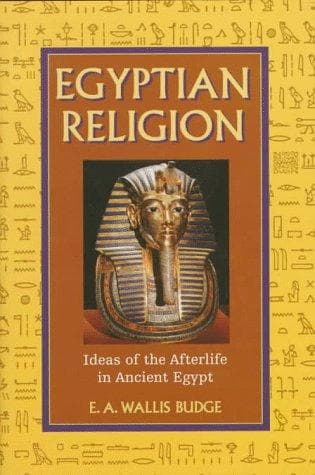
Egyptian Ideas of the Future LifeBudge, E. A. Wallis (Ernest Alfred Wallis), Sir
ReligionComparative
Egyptian Ideas of the Future Life
Budge, E. A. Wallis (Ernest Alfred Wallis), Sir
Egypt -- Religion; Eschatology, Egyptian; Future life
"Isis fed the child by giving it her finger to suck instead of the
breast; she likewise put him every night into the fire in order to
consume his mortal part, whilst transforming herself into a swallow,
she hovered round the pillar and bemoaned her sad fate. Thus continued
she to do for some time, till the queen, who stood watching her,
observing the child to be all in a flame, cryed out, and thereby
deprived him of that immortality which would otherwise have been
conferred upon him. The Goddess upon this, discovering herself,
requested that the pillar, which supported the roof, might be given
her; which she accordingly took down, and then easily cutting it open,
after she had taken, out what she wanted, she wrapped up the remainder
of the trunk in fine linnen, and pouring perfumed oil upon it,
delivered it again into the hands of the king and queen (which piece
of wood is to this day preserved in the temple of Isis, and worshipped
by the people of Byblos). When this was done, she threw herself upon
the chest, making at the same time such a loud and terrible
lamentation over it, as frightened the younger of the king's sons, who
heard her, out of his life. But the elder of them she took with, her
and set sail with the chest for Egypt; and it being now about morning,
the river Phaedrus sending forth a rough and sharp air, she in her
anger dried up its current.
"No sooner was she arrived at a desart place, where she imagined
herself to be alone, but she presently opened the chest, and laying
her face upon her dead husband's, embraced his corpse, and wept
bitterly; but, perceiving that the little boy had silently stolen
behind her, and found out the occasion of her grief, she turned
herself about on the sudden, and in her anger gave him so fierce and
stern a look that he immediately died of the affright. Others indeed
say that his death did not happen in this manner, but, as was hinted
above, that he fell into the sea, and afterwards received the greatest
honours on account of the Goddess; for that the Maneros, [Footnote: A
son of the first Egyptian king, who died in his early youth; see
Herodotus, ii. 79.] whom the Egyptians so frequently call upon in
their banquets, is none other than this very boy. This relation is
again contradicted by such as tell us that the true name of the child
was Palaestinus, or Pelusius, and that the city of this name was built
by the Goddess in memory of him; adding farther, that the Maneros
above mentioned is thus honoured by the Egyptians at their feasts,
because he was the first who invented music. There are others, again,
who affirm that Maneros is not the name of any particular person, but
a mere customary form, and complimental manner of greeting made use of
by the Egyptians one towards another at their more solemn feasts and
banquets, meaning no more by it, than to wish, that what they were
Public-domain text, read in full here on John Shaqi.
Reviews
Reviews
No reviews yet
Be the first to share your thoughts on this work.
Join the Discussion
Join the discussion
Sign in to leave a comment or review.
Sign InorCreate an account