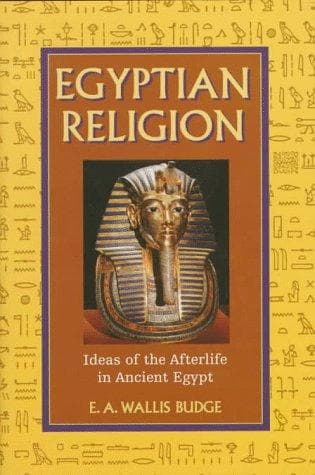
Egyptian Ideas of the Future LifeBudge, E. A. Wallis (Ernest Alfred Wallis), Sir
ReligionComparative
Egyptian Ideas of the Future Life
Budge, E. A. Wallis (Ernest Alfred Wallis), Sir
Egypt -- Religion; Eschatology, Egyptian; Future life
A study of ancient Egyptian religious texts will convince the reader
that the Egyptians believed in One God, who was self-existent, immortal,
invisible, eternal, omniscient, almighty, and inscrutable; the maker of
the heavens, earth, and underworld; the creator of the sky and the sea,
men and women, animals and birds, fish and creeping things, trees and
plants, and the incorporeal beings who were the messengers that
fulfilled his wish and word. It is necessary to place this definition of
the first part of the belief of the Egyptian at the beginning of the
first chapter of this brief account of the principal religious ideas
which he held, for the whole of his theology and religion was based upon
it; and it is also necessary to add that, however far back we follow his
literature, we never seem to approach a time when he was without this
remarkable belief. It is true that he also developed polytheistic ideas
and beliefs, and that he cultivated them at certain periods of his
history with diligence, and to such a degree that the nations around,
and even the stranger in his country, were misled by his actions, and
described him as a polytheistic idolater. But notwithstanding all such
departures from observances, the keeping of which befitted those who
believed in God and his unity, this sublime idea was never lost sight
of; on the contrary, it is reproduced in the religious literature of all
periods. Whence came this remarkable characteristic of the Egyptian
religion no man can say, and there is no evidence whatsoever to guide us
in formulating the theory that it was brought into Egypt by immigrants
from the East, as some have said, or that it was a natural product of
the indigenous peoples who formed the population of the valley of the
Nile some ten thousand years ago, according to the opinion of others.
All that is known is that it existed there at a period so remote that it
is useless to attempt to measure by years the interval of time which has
elapsed since it grew up and established itself in the minds of men, and
that it is exceedingly doubtful if we shall ever have any very definite
knowledge on this interesting point.
Public-domain text, read in full here on John Shaqi.
Reviews
Reviews
No reviews yet
Be the first to share your thoughts on this work.
Join the Discussion
Join the discussion
Sign in to leave a comment or review.
Sign InorCreate an account