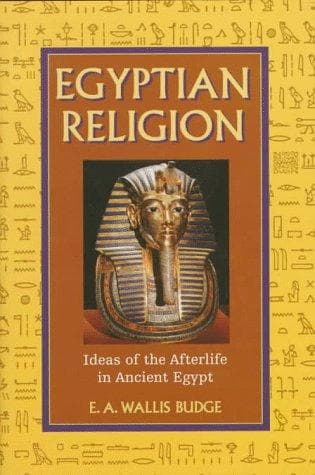
Egyptian Ideas of the Future LifeBudge, E. A. Wallis (Ernest Alfred Wallis), Sir
ReligionComparative
Egyptian Ideas of the Future Life
Budge, E. A. Wallis (Ernest Alfred Wallis), Sir
Egypt -- Religion; Eschatology, Egyptian; Future life
The deceased then identifying himself with Khepera, the god who created
Osiris and his company of gods, says:--
"I am the god Khepera, and my members shall have an everlasting
existence. I shall not decay, I shall not rot, I shall not putrefy, I
shall not turn into worms, and I shall not see corruption under the
eye of the god Shu. I shall have my being, I shall have my being; I
shall live, I shall live; I shall germinate, I shall germinate, I
shall germinate; I shall wake up in peace. I shall not putrefy; my
bowels shall not perish; I shall not suffer injury; mine eye shall not
decay; the form of my countenance shall not disappear; mine ear shall
not become deaf; my head shall not be separated from my neck; my
tongue shall not be carried away; my hair shall not be cut off; mine
eyebrows shall not be shaved off, and no baleful injury shall come
upon me. My body shall be stablished, and it shall neither fall into
ruin, nor be destroyed on this earth."
Judging from such passages as those given above we might think that
certain of the Egyptians expected a resurrection of the physical body,
and the mention of the various members of the body seems to make this
view certain. But the body of which the incorruption and immortality are
so strongly declared is the S[=A]HU; or spiritual body, that sprang into
existence out of the physical body, which had become transformed by
means of the prayers that had been recited and the ceremonies that had
been performed on the day of the funeral, or on that wherein it was laid
in the tomb. It is interesting to notice that no mention is made of meat
or drink in the CLIVth Chapter, and the only thing which the deceased
refers to as necessary for his existence is air, which he obtains
through, the god Temu, the god who is always depicted in human form; the
god is here mentioned in his aspect of the night Sun as opposed to R[=a]
the day Sun, and a comparison of the Sun's daily death with the death of
the deceased is intended to be made. The deposit of the head of the God-man
Osiris at Abydos has already been mentioned, and the belief that it
was preserved there was common throughout Egypt. But in the text quoted
above the deceased says, "My head shall not be separated from my neck,"
which seems to indicate that he wished to keep his body whole,
notwithstanding that Osiris was almighty, and could restore the limbs
and reconstitute the body, even as he had done for his own limbs and
body which had been hacked to pieces by Set. Chapter XLIII of the Book
of the Dead [Footnote: See _The Chapters of Coming Forth by Day_, p.
98.] also has an important reference to the head of Osiris. It is
entitled "The Chapter of not letting the head of a man be cut off from
him in the underworld," and must be of considerable antiquity. In it the
deceased says: "I am the Great One, the son of the Great One; I am Fire,
and the son of the Fire, to whom was given his head after it had been
cut off.
Public-domain text, read in full here on John Shaqi.
Reviews
Reviews
No reviews yet
Be the first to share your thoughts on this work.
Join the Discussion
Join the discussion
Sign in to leave a comment or review.
Sign InorCreate an account