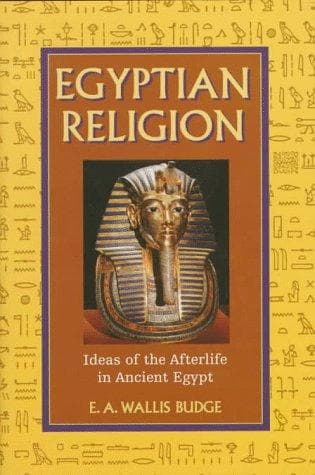
Egyptian Ideas of the Future LifeBudge, E. A. Wallis (Ernest Alfred Wallis), Sir
ReligionComparative
Egyptian Ideas of the Future Life
Budge, E. A. Wallis (Ernest Alfred Wallis), Sir
Egypt -- Religion; Eschatology, Egyptian; Future life
The spiritual intelligence, or spirit, of a man was called KHU, and it
seems to have taken form as a shining, luminous, intangible shape of the
body; the KHUs formed a class of celestial beings who lived with the
gods, but their functions are not clear. The KHU, like the KA, could be
imprisoned in the tomb, and to obviate this catastrophe special formulae
were composed and duly recited. Besides the KHU another very important
part of a man's entity went into heaven, namely, his SEKHEM. The word
literally means "to have the mastery over something," and, as used in
the early texts, that which enables one to have the mastery over
something; _i.e._, "power." The SEKHEM of a man was, apparently, his
vital force or strength personified, and the Egyptians believed that it
could and did, under certain conditions, follow him that possessed it
upon earth into heaven. Another part of a man was the KHAIBIT or
"shadow," which is frequently mentioned in connexion with the soul and,
in late times, was always thought to be near it. Finally we may mention
the REN, or "name" of a man, as one of his most important constituent
parts. The Egyptians, in common with all Eastern nations, attached the
greatest importance to the preservation of the name, and any person, who
effected the blotting out of a man's name was thought to have destroyed
him also. Like the KA it was a portion, of a man's most special
identity, and it is easy to see why so much importance grew to be
attached to it; a nameless being could not be introduced to the gods,
and as no created thing exists without a name the man who had no name
was in a worse position before the divine powers than the feeblest
inanimate object. To perpetuate the name of a father was a good son's
duty, and to keep the tombs of the dead in good repair so that all might
read the names of those who were buried in them was a most meritorious
act. On the other hand, if the deceased knew the names of divine beings,
whether friends or foes, and could pronounce them, he at once obtained
power over them, and was able to make them perform his will.
Public-domain text, read in full here on John Shaqi.
Reviews
Reviews
No reviews yet
Be the first to share your thoughts on this work.
Elsewhere in the archive
Join the Discussion
Join the discussion
Sign in to leave a comment or review.
Sign InorCreate an account