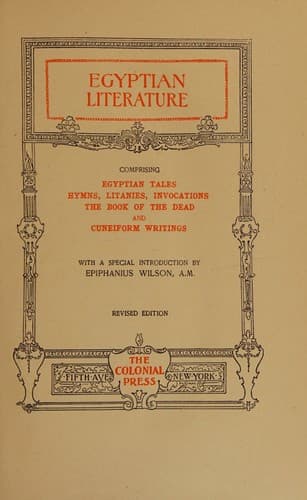
Egyptian Literature: Comprising Egyptian tales, hymns, litanies, invocations, the Book of the Dead, and cuneiform writings
Religion
Egyptian Literature: Comprising Egyptian tales, hymns, litanies, invocations, the Book of the Dead, and cuneiform writings
Egyptian literature -- Translations into English
36 B.—“To the King ... thus _Aziru_: seven times and seven times at ... of
my God and Sun. Behold truly thou hast known this, O King my Lord; behold
I am thy servant forever; from my Lord’s commands I never rebel: my Lord
from of old (it has been) thus. I am kind to the men who are servants of
my King; but the chiefs of the city _Simyra_ have not kept faith
righteously with us; and behold neither one nor all are with us: my Lord
the King did not you cause to be asked? The King my Lord has known that
the chiefs are sinful; and why ask, ‘What does he contend for?’ I say nay
...”
From these letters by Aziru, we must conclude either that he was a great
liar or that he was induced to change sides later. The other
correspondents seem to have believed that he had long deceived the King of
Egypt; but, in the end, his invasion of Phœnicia—perhaps cloaked by
pretences of hostility to the Hittite league—caused him, as we shall see,
to be proclaimed a rebel. The quarrel with Simyra may have been due to his
being pushed south, out of his dominions, but is here said to be due to a
Phœnician league with his foes. It does not appear who Khatib was. Perhaps
the name was Hittite,(197) and he may have been the Prince of Hamath or of
Emesa. The following letter from Aziru’s father, Abdasherah, belongs to a
later period of the war, when Ullaza and all the cities north of Gebal had
been conquered by the Amorites. It is couched in the same insidious
language; and the letters of Ribadda, which follow, show that Amenophis
was not open to conviction for a long time, though warned by his true
friends. The proclamation is still later, after the attack on Sidon, and
may fitly conclude the Amorite correspondence.
97 B.—“To the King my Son my Lord thus _Abdasratu_(198) thy servant, the
dust of thy feet. At the feet of the King my Lord seven times and seven
times I bow. Behold I am the King’s servant, and a dog who is his neighbor
(or his ‘friend’?); and all the land of the Amorites is his. I often said
to _Pakhanati_(199) my _Paka_ (Egyptian resident), ‘Let him gather
soldiers to defend the people of this King.’ Now all (cursed?) as King,
the King of the Phœnician (_Kharri_) soldiers ... _Kharri_: the King shall
ask if I do not guard the city of _Simyra_ (and) the city _Ullaza_. Lo my
_Paka_ is in her: I proclaim the Sun-King; and I have (given orders?) to
obey. The city _Simyra_ is a neighbor,(200) and all the lands are the
King’s—my Sun, my Lord; I watch for him: and I know that the King my Lord
is very glorious; and _Pakhanati_ my _Paka_ is established to judge
therein.”
COPY OF A PROCLAMATION AGAINST AZIRU, SENT TO EGYPT BY KHANNI, WHEN SENT
AGAIN TO SYRIA
Public-domain text, read in full here on John Shaqi.
Reviews
Reviews
No reviews yet
Be the first to share your thoughts on this work.
Elsewhere in the archive
Join the Discussion
Join the discussion
Sign in to leave a comment or review.
Sign InorCreate an account