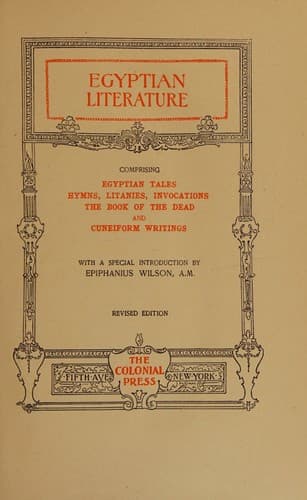
Egyptian Literature: Comprising Egyptian tales, hymns, litanies, invocations, the Book of the Dead, and cuneiform writings
Religion
Egyptian Literature: Comprising Egyptian tales, hymns, litanies, invocations, the Book of the Dead, and cuneiform writings
Egyptian literature -- Translations into English
“Horus repeated [these] words four times, and all his enemies fell
headlong and were overthrown and were cut to pieces; and Osiris Auf-ānkh,
triumphant, repeated [these] words four times, therefore let all his
enemies fall headlong, and be overthrown and cut to pieces. Horus the son
of Isis and son of Osiris celebrated in turn millions of festivals, and
all his enemies fell headlong, and were overthrown and cut to pieces.
Their habitation hath gone forth to the block of the East, their heads
have been cut off; their necks have been destroyed; their thighs have been
cut off; they have been given over to the Great Destroyer who dwelleth in
the valley of the grave; and they shall never come forth from under the
restraint of the god Seb.”
THIS CHAPTER SHALL BE RECITED OVER THE DIVINE CHAPLET WHICH IS LAID UPON
THE FACE OF THE DECEASED, AND THOU SHALT CAST INCENSE INTO THE FIRE ON
BEHALF OF OSIRIS AUF-ANKH, TRIUMPHANT, BORN OF SHERET-AMSU, TRIUMPHANT;
THUS SHALT THOU CAUSE HIM TO TRIUMPH OVER HIS ENEMIES, DEAD OR ALIVE, AND
HE SHALL BE AMONG THE FOLLOWERS OF OSIRIS; AND A HAND SHALL BE STRETCHED
OUT TO HIM WITH MEAT AND DRINK IN THE PRESENCE OF THE GOD. [THIS CHAPTER]
SHALL BE SAID BY THEE TWICE AT DAWN—NOW IT IS A NEVER-FAILING
CHARM—REGULARLY AND CONTINUALLY.
The Chapter Of The Victory Over Enemies.
[From the Papyrus of Nebseni (British Museum No. 9,900, sheet 12).]
“Hail, Thoth, who didst make Osiris to triumph over his enemies, snare
thou the enemies of Osiris, the scribe Nebseni, the lord of piety, in the
presence of the great sovereign princes of every god and of every goddess;
in the presence of the great sovereign princes who are in Annu
(Heliopolis) on the night of the battle and of the overthrow of the
Sebau-fiend in Tattu; on the night of making to stand up the double Tet in
Sekhem (Letopolis); on the night of the things of the night in Sekhem, in
Pe, and in Tepu;(18) on the night of the stablishing of Horus in the
heritage of the things of his father in the double land of Rekhti(?); on
the night when Isis maketh lamentation at the side of her brother Osiris
in Abtu (Abydos); on the night of the Haker festival of the distinguishing
[between] the dead (_i.e._, the damned) and the _Khu_s on the path of the
dead (_i.e._, the damned); on the night of the judgment of those who are
to be annihilated at the great [festival of] the ploughing and the turning
up of the earth in Naare-rut-f(19) in Re-stau; and on the night of making
Horus to triumph over his enemies. Horus is mighty, the northern and
southern halves of heaven rejoice, Osiris is content thereat and his heart
is glad. Hail, Thoth, make thou to triumph Osiris, the scribe Nebseni,
over his enemies in the presence of the sovereign princes of every god and
every goddess, and in the presence of you, ye sovereign princes who passed
judgment on Osiris behind the shrine.”
Public-domain text, read in full here on John Shaqi.
Reviews
Reviews
No reviews yet
Be the first to share your thoughts on this work.
Join the Discussion
Join the discussion
Sign in to leave a comment or review.
Sign InorCreate an account