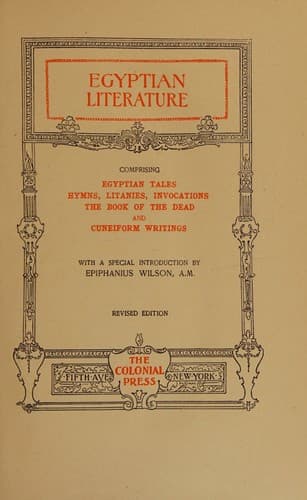
Egyptian Literature: Comprising Egyptian tales, hymns, litanies, invocations, the Book of the Dead, and cuneiform writings
Religion
Egyptian Literature: Comprising Egyptian tales, hymns, litanies, invocations, the Book of the Dead, and cuneiform writings
Egyptian literature -- Translations into English
14 B. M.—“_Ribadda_ speaks to his Lord the King of many lands the Great
King. Baalath of Gebal has given power to the King my Lord: at the feet of
my Lord, my Sun, seven times seven times I bow. Why wilt not thou utter
for us a message to me? And (now) know the demand which my chief is
despatched to make in presence of the King my Lord; and his division of
horse has marched, but the man has delayed marching—its chief—as the
letters to the King were not given to the hand of my chief ... as to what
has been said ... of your land, is it not needful that the allies of the
_Paka_ should march to the men of blood; have not all the lands been
grieved? It will be necessary for the allies, but they come not being
slow. Moreover I sent for men of garrison and for horses, but you care not
for us (even) to return us a message for me. And I am destroyed by
_Abdasherah_ like _Yapaaddu_ and _Zimridi_—and they are fugitives.
Moreover, the revolt of the city of _Simyra_ and of the city _Saarti_(237)
continues against him. We remain under the hand of _Yankhamu_; and he
gives us corn for my eating. We two guard the King’s city for him, and he
collects for the King, and orders my chief, appointing chiefs to assist
for me, fulfilling the decree which thou hast thyself appointed. We have
trusted in the King. And two chiefs of the city have been despatched to be
sent, having come down bound from the camp of _Yankhamu_. Moreover, as to
this assistance to _Yankhamu_, _Ribadda_ is in your hands, and all that is
done for him (is) before you; it is not for me to punish thy soldiers. My
superior is over me. And I will send to him if you do not speak about
this, or he gives up the city, or I depart. Moreover, if you do not utter
for us a message for me, both the city will be surrendered, and I shall go
away with the men who support me. And learn that our corn also is failing,
and _Milcuru_ has measured the corn—measure of _Baalath_(238) ... very
much ...”
89 B.—This is much broken. After the usual salutation he says that
Abdasherah has fought strongly, and has seized cities belonging to Gebal;
that news has reached the city as to what has befallen the city _Ammia_
(_Amyun_) from the men of blood. A certain _Berber_(239) chief is
mentioned. He speaks of “two months,” apparently as the limit of time in
which he expects to be aided by the _bitati_, or Egyptian soldiers.
Abdasherah is marching on Gebal.
79 B.—Also broken. With the usual salutation, speaks of a great fight with
the men of blood, who made an end of men, women, and soldiers of his poor
country. He sent men, and they were beaten. The city of _Irkata_ (Arkah)
is mentioned, and the King of the _Hittites_, who is making war on all the
lands. The King of _Mitani_ will be king of the weak (or false) land of
the writer’s people. He concludes by calling _Abdasherah_ a dog.
Public-domain text, read in full here on John Shaqi.
Reviews
Reviews
No reviews yet
Be the first to share your thoughts on this work.
Elsewhere in the archive
Join the Discussion
Join the discussion
Sign in to leave a comment or review.
Sign InorCreate an account